The best used car for towing a caravan should offer reliability, stability and practicality, providing caravanners with a budget-friendly way of entering the world of touring or upgrading an existing vehicle.
While the best tow cars may feature the latest mod cons and provide good fuel efficiency, a used car for towing a caravan should still share many of the same traits, including that all-important stability.
After all, a lot of muscle will be required to remain stable while pulling a van. As a result, you’ll want to pick a used car for towing that has a number of talents to ensure it can get you and your tourer safely from A to B. You may have a lightweight tourer, in which case you may find a small tow car best suits your requirements, or perhaps you own a heavy twin-axle, in which case a tow car for a 2000kg caravan will fit the bill.
To help you find the option for you, we’re sharing our pick of the best used tow cars, featuring vehicles from leading brands such as Škoda, BMW, Kia and more.
The best used cars for towing caravans are:
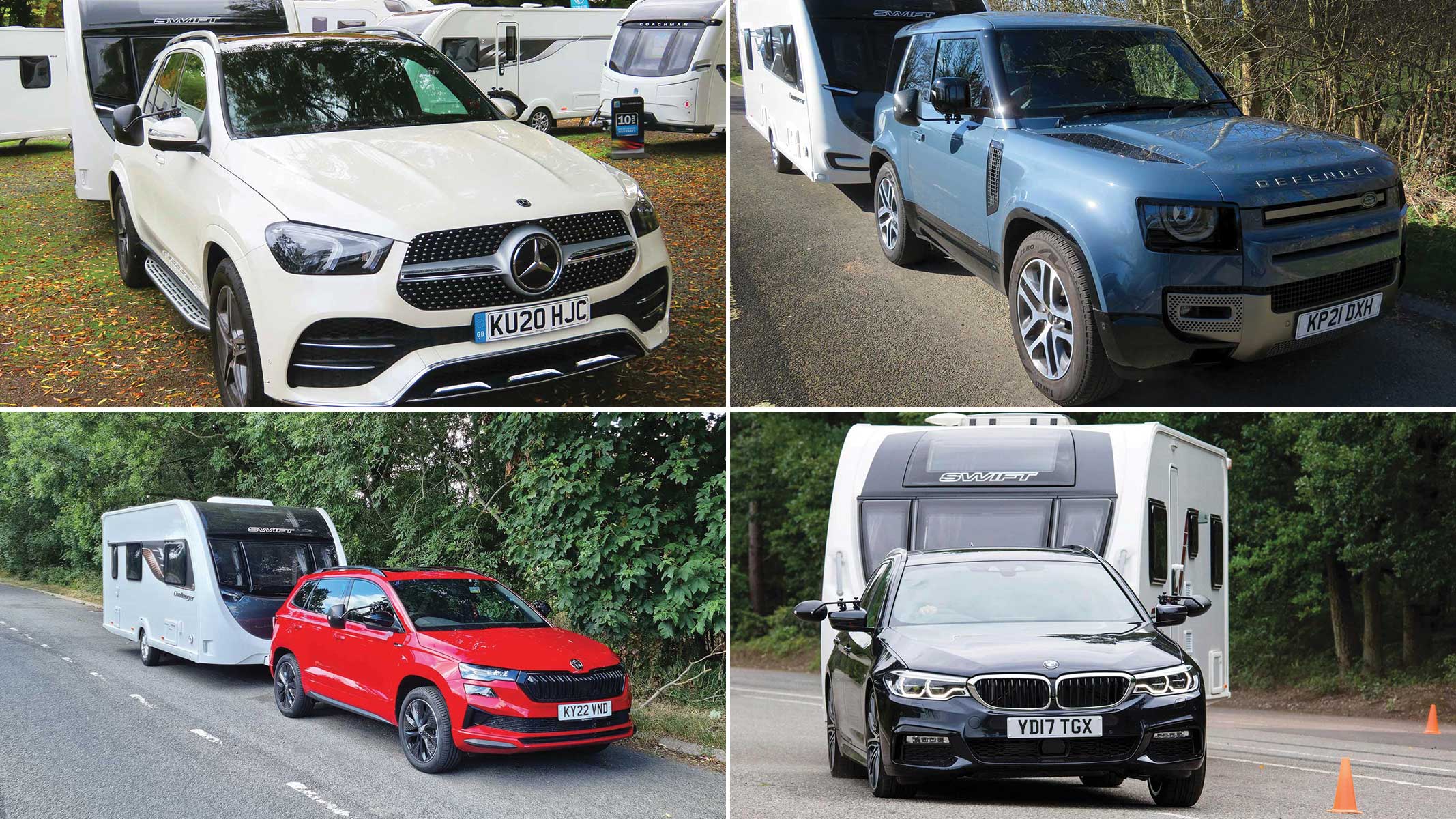
Škoda Karoq
BMW 5 Series Touring
Mercedes-Benz GLE
Nissan X-Trail Mk3
Cupra Formentor
Land Rover Defender
Kia Sorento
Ford Mondeo
Dacia Duster
VW T-Cross
Land Rover Discovery 4
The best used tow cars:

Škoda Karoq
- Kerbweight: 1561kg
- Towing limit: 2000kg
- Noseweight limit: 88kg
- 85% match: 1327kg
Reason to buy:
- Offers good tech, towing skills and a spacious interior
Reason to avoid:
- Requires finding an option with VarioFlex if you want to be able to remove the back seats
Coming with an interior that can only be described as classy, the Škoda Karoq is a used tow car which is aimed at families. It provides plenty of room, both up front and in the rear, and we like the inclusion of wide-opening doors, which makes getting in and out of the car that bit easier.
Boot space starts at 479 litres but can be increased to 588 litres by sliding the rear seats forwards – alternatively, fold them down to achieve even more space. This does leave a ridge, but if that’s something you want to avoid, you could opt for the SE L or Edition model, which offers the flexibility of removing the rear seats. It was also an option on lower-spec models, known as VarioFlex, and we would recommend looking out for it just for the convenience it provides.
The entry-level SE models also come with an excellent level of kit, including dual-zone climate control, electric windows, cruise control, and an infotainment system with Apple CarPlay and Android Auto.
There are numerous engines to choose from, but our favourite is the 148bhp 2.0 TDI, especially if you can find a four-wheel drive with the DSG dual-clutch gearbox. This is one that takes hill starts in its stride and has just enough punch. Suspension is soft, ensuring it’s comfortable, and the light steering makes you feel in control, even if there can be the odd bit of movement on a windy day when towing at speed.
With a good mix of tech and towing abilities, as well as a spacious interior, we think Skoda makes a very impressive used car for towing a caravan.
Full review: Škoda Karoq
BMW 5 Series Touring
- Kerbweight: 1875kg
- Towing limit: 2000kg
- Noseweight limit: 90kg
- 85% match: 1594kg
Reason to buy:
- An estate which gives you plenty of space, an impressive interior, and tows confidently
Reason to avoid:
- It won’t suit fans of SUVs
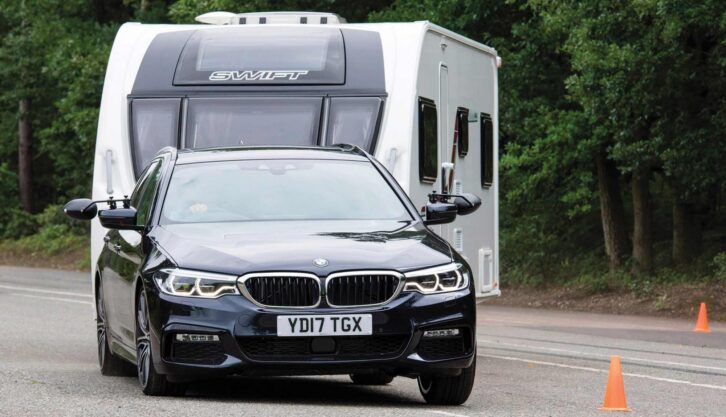
The BMW 5 Series Touring makes a highly tempting second-hand car for towing a caravan for those who have decided they’d rather drive an estate and enjoy the lower centre of gravity it provides in contrast to an SUV.
For those who prioritise space in a used tow car, this is part of a range which is incredibly roomy, providing plenty of space whether you’re sitting in the front or the back – although we’d suggest bearing in mind the large central transmission tunnel, due to it being a rear-wheel drive, so anyone in the rear middle seat would be straddling it.
There’s plenty of space for storage, with a 570-litre area if you’re using the rear seats, or an impressive 1700 litres if you’re not. It makes a nicely kitted-out second-hand tow car too, even if you opt for an entry-level SE – here, you’ll find there’s parking sensors at both ends, climate and cruise control, navigation, and more.
The interior impresses just as much, with our used tow car expert Euan Doig commenting it would make “you feel rather special every time you get inside the car.”
There’s a choice of plug-in hybrid, diesel or petrol engines, although we’d say the diesel would be the best choice for caravanners, offering excellent torque and decent fuel economy.
Take the 530d xDrive, which combines four-wheel drive with a 3.0-litre turbodiesel engine. The end result is an excellent performance, with confident towing and stability at speed, even in windy conditions on a motorway.
It’s a fun solo drive too, and you could be surprised by how agile it is for its size, while its official economy of 51.3mpg is impressive – this is a car which really does tick every box if you’re happy to go for an estate.
This truly is an excellent used car for towing, providing a spacious interior, a good level of equipment, a strong towing performance, and plenty of comfort, as well as some decent fuel economy. The only thing to bear in mind is that it’s not likely to be the cheapest used tow car you can find, with a 2023 530d Touring M Sport xDrive costing £40,995, for instance.
Full review: BMW 5 Series Touring
Mercedes-Benz GLE
- Kerbweight: 2265kg
- Towing limit: 3500kg
- Noseweight limit: 120kg
- 85% match: 1925kg
Reason to buy:
- A very luxurious car with plenty of space, a good level of equipment, and tows well
Reason to avoid:
- It’s expensive
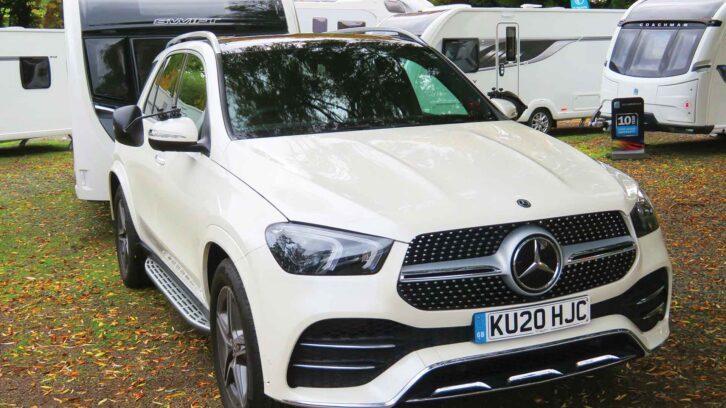
If you’re prioritising luxury when choosing the best used car for towing a caravan, this may just be the one for you. The second generation of this car offers plenty of space for those seated at the front, while anyone in the middle will also be able to enjoy plenty of legroom. Ok, any passengers in the final rear seats may feel a little cooped up, but the middle row can be moved forward if required to provide more leg space.
If each seat is used, luggage will be limited, but fold the rear two down, and you get 630 litres – fold down the middle seats, and there’s a very impressive 2055 litres to play with.
Equipment in this car can only be called impressive, with entry-level models featuring a reversing camera, LED headlights, 20-inch alloys, and parking sensors.
Go for an AMG Line Premium model, and you get a surround-view camera system, while the AMG Line Premium Plus adds a Burmester stereo unit and an interior fragrance system. You do need to factor in the price, though; that luxury comes at a cost.
So we know it offers a spacious interior and a good level of kit; what about the towing experience? Many powertrains are diesel, with the base-model four-cylinder 300d providing a strong, albeit slightly noisy experience.
Opt for the 400d (see our review of the 2021 Mercedes-Benz GLE 400 D AMG Line Premium Plus), and you get a six-cylinder with smooth and strong performance, with its nine-speed automatic gearbox effective. The driving experience is incredibly comfortable, and its heavy weight allows it to tow effectively, with hill starts no problem.
Full review: Mercedes-Benz GLE
Cupra Formentor
- Kerb weight: 1704kg
- Towing limit: 1700kg
- Nose weight limit: 80kg
- 85% match: 1448kg
Reason to buy:
- Spacious cab, enjoyable to drive solo, makes towing easy
Reason to avoid:
- Central infotainment system isn’t the easiest to use, watch out for wheelspin
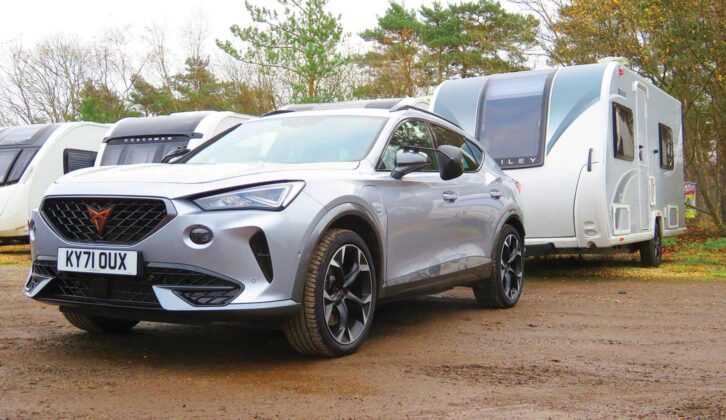
Cupra’s first standalone car really does make a good used towing car. The ‘coupé-crossover’ looks good and is a bit different to some of its rivals, in that the driver’s seat is closer to the road – unusual for an SUV.
It’s a spacious cab too, with room between the two people in the front, but we would highlight that these seats are better suited to more slender proportions. Those in the rear aren’t hard done by either, with good headroom and legroom for three occupants, even if the central tunnel could mean anyone sitting in the middle will have picked the short straw.
Boot space will vary from 345 litres if you opt for the plug-in hybrid to 450 litres for a two-wheel drive petrol model. One thing we did find, however, is that the central infotainment system isn’t the simplest to use.
When it comes to the driving performance, you can choose from a few powertrains, including a plug-in hybrid with a 148bhp 1.4 turbo petrol engine (you may see it with a 1.5 as it was subsequently changed) with a battery and 113bhp electric motor, which produces 201bhp to make towing simple, although you will need to watch out for wheelspin. A weight of 1704kg gives some good car/caravan matching options, and it tows well, while driving unhitched is an enjoyable experience.
With good looks and a nice level of kit, the Cupra is a car which we think makes a good used plug-in hybrid tow car.
Full review: Cupra Formentor
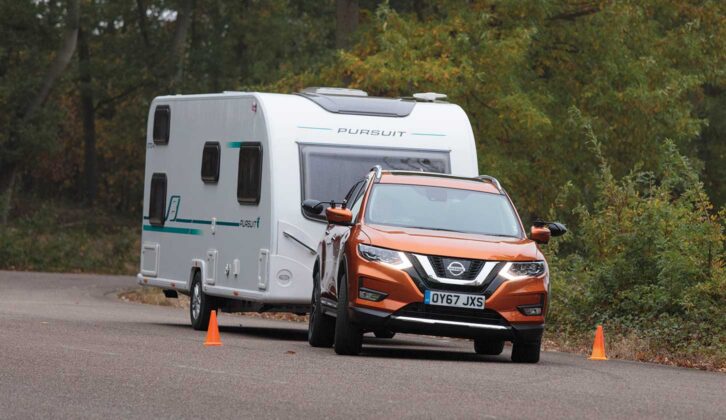
Nissan X-Trail Mk3
- Kerb weight: 1880kg
- Towing limit: 1800kg
- Nose weight limit: 100kg
- 85% match: 1598kg
Reason to buy:
- Excellent at towing, good space for everyone, good kit level
Reason to avoid:
- Fuel economy isn’t amazing
The third generation of the X-Trail is a very capable secondhand towing car.
Depending on the powertrain, it should be available as a five- or seven-seater car, and it provides plenty of space for everyone, with good legroom and headroom. Even in the middle, three adults could sit next to each other without an issue, and as a seven-seater, two children could sit in the rearmost seats.
Fold all the seats down to get 1396 litres of boot space, or 575 when the rear seats are in use (which we reckon will give you plenty of space for luggage).
We’re impressed by the kit too; Apple CarPlay and Android Auto come with each model, and climate control has separate buttons.
We particularly like the e-Force model, thinking it makes an excellent towing car. Coming on a hybrid powertrain, we thought performance was effective, the engine quiet, and it offers that all-important trait of stability when towing. However, one thing we did note; we only achieved 21.4mpg when testing it.
It may not be the most sporty option out there, but realistically, you’re not going to be looking for that in an X-Trail.
Full review: Nissan X-Trail Mk3

Land Rover Defender
- Kerbweight: 2380kg
- Towing limit: 3500kg
- Noseweight limit: 150kg
- 85% match: 2023kg
Reason to buy:
- Well-equipped, excellent at driving, great match figure
Reason to avoid:
- Acceleration is “stately”, thirsty to drive
Luxurious, rugged and spacious are just three of the words that can be used to describe the Defender. Opt for the 110 with its longer wheelbase and we’d have to label the amount of space you get up front as “vast” – and it’s nearly as good in the second row. An optional third row can also be found, but we should highlight that the rearmost two seats don’t offer huge amounts of space.
We’d recommend opting for the five, as you then have the option of as much as 1826 litres of boot space once you’ve lowered all of the seats. It also makes a well-equipped secondhand tow car, with features like dual-zone climate control, Pivi Pro infotainment, air suspension and electrically adjustable front seats.
The 110 is not going to be winning any races with its acceleration, which our reviewer described as “stately”, despite a 2.0-litre diesel engine that can produce 237bhp and 317lb ft of torque – this is because it comes to nearly 2.4 tonnes.
It’s also thirsty – particularly when towing. If these are traits you’re willing to work with, you’ll find this is a used tow car which is steady, no matter the conditions or tourer, with only mild tugging when passing large vehicles on windy days. Hill starts are easy, slippery surfaces pose no problem, and manoeuvres are simplified by a 360-degree camera system.
Full review: Land Rover Defender
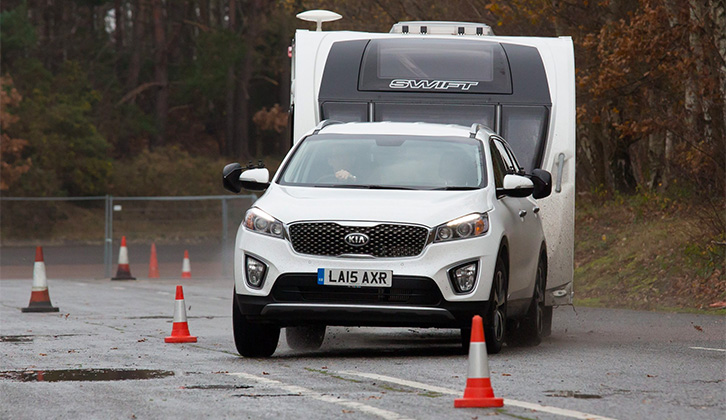
Kia Sorento
- Kerbweight: 1953kg
- Maximum Towing Limit: 2000kg
- Towball limit: 100kg
- 85% match: 1660kg
Reason to buy:
- Great performance and towing abilities, provides space for seven
Reason to avoid:
- Other rivals are more fuel-efficient
If you don’t own a Kia Sorento, the chances are you will know someone who does. It’s one of Britain’s most popular tow cars.
It makes a cracking buy if you want a used car for towing a caravan too. New examples are more expensive than they used to be, so if you want to grab a very capable towing vehicle at a bargain price, the pre-owned market is the way to go. And don’t forget, Kia’s warranty lasts for seven years.
The Sorento we tested in 2016 impressed us with its high kerbweight, slick automatic gearbox, and muscular diesel engine. We liked the roomy seven-seat interior, too.
Full review: Kia Sorento
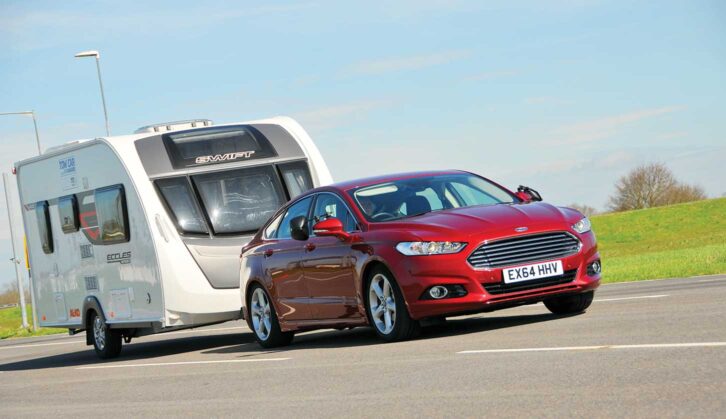
Ford Mondeo
- Kerbweight: 1578kg
- Towing limit: 1600kg
- Noseweight limit: 75kg
- 85% match: 1341kg
Reason to buy:
- Good boot space, spacious interior, provides a smooth drive
Reason to avoid:
- Not as fun to drive as earlier generations, boot floor has a step
A used Ford Mondeo is well worth considering when you’re looking for a used car for towing, providing comfort, space, economy and good levels of equipment.
Ignoring the saloon hybrid, the Mondeo came as either an estate or a hatchback, and both options offer plenty of room, both upfront and in the row behind.
We think boot space is excellent too, ranging from 541 litres to 1437 litres when the back row isn’t being used, although one thing we will highlight is the step in the boot floor. One thing we did think about this generation of Mondeo – it’s not quite as fun to drive as earlier versions, even if it is more comfortable and refined. The result is that while steering is a little light and the response a little slower, it still matches the likes of the VW Passat once you’re on the motorway.
We think the 2.0-litre TDCi diesel in particular offers a smooth driving experience, and it can be found as either a 148bhp or 178bhp. With 258lb ft of torque, it can tow without trouble; opt for the 178bhp car and you’ll get 295lb ft of power.
It drives confidently, providing stability on the motorway and confidence on hill starts. Plus, the fuel economy is very good, with nearly 70mpg.
Full review: Ford Mondeo
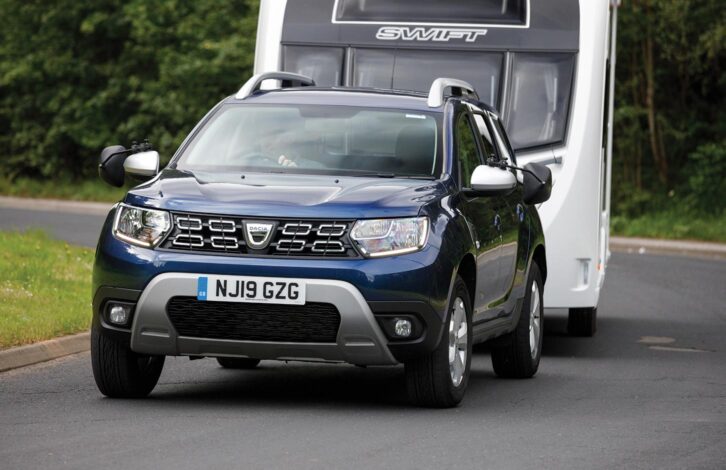
Dacia Duster
- Kerbweight: 1480kg
- Towing limit: 1500kg
- Noseweight limit: 75kg
- 85% match: 1258kg
Reason to buy:
- Inexpensive, provides a good ride
Reason to avoid:
- Lightweight, some may find it too basic
If you’re looking for an inexpensive option and have a smaller van, this Dacia, a winner in its class at the Tow Car of the Year Awards 2019, could be the best used tow car for you.
Headroom isn’t an issue, whether you’re sitting in the front or back – however, both could do with improved legroom.
We’d say the 130bhp 1.3-litre model is the best all-rounder petrol vehicle, but regular towers will probably be more interested in a four-wheel drive, in which case we’d suggest the 1.5-litre 115bhp diesel engine. It may not be pacey but it’s strong and doesn’t have too much of a thirst.
Thanks to the Duster’s high-profile tyres and soft suspension, it provides a good ride too, although twisty roads are more of a struggle.
Hill starts and lane changes pose no problems though, even if the suspension leads to wobbles from side winds.
However, something we should highlight is that it achieved a three-star Euro NCAP crash result.
It may be a bit too basic for some, as it doesn’t hide its budget origins – the entry-level Access range included no audio – but we think this makes a great used towing car.
Full review: Dacia Duster
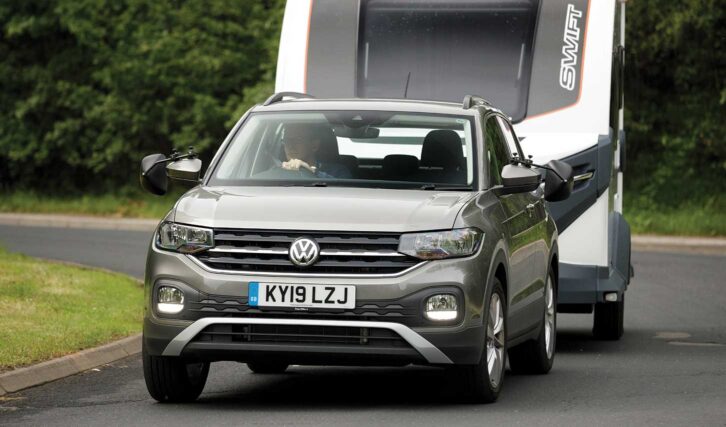
VW T-Cross
- Kerbweight: 1270kg
- Towing limit: 1100kg
- Noseweight limit: 55kg
- 85% match: 1080kg
Reason to buy:
- Provides a comfortable towing experience for owners of smaller vans
Reason to avoid:
- Build quality could be better, not the best boot space
For owners of the best small caravans, this VW is a used tow car which could be a tempting no-fuss option.
It’s a small SUV which is based on the VW Polo’s underpinnings, but it still manages to provide a good amount of interior space. Everyone can sit in comfort, even on longer trips, while the rear seats can be moved backwards or forwards, allowing you to prioritise either more boot space or extra legroom, as the situation dictates.
It is, however, worth noting that the boot space is never going to be fantastic in a smaller car. We also thought the interior build quality felt a bit subpar. As a result, we’d advise checking for any rattles or signs of wear and tear before buying.
Equipment levels are good, though, with an entry-level T-Cross coming with air-con, a DAB radio, and variable-height front seats, but we’d suggest an SE if you can, as it comes with larger alloys, adaptive cruise control, automatic wipers, and more.
Thanks to its 113bhp 1.0-litre engine, a smaller tourer can be towed comfortably, and we found the seven-speed DSG transmission was a good match, swapping ratios smoothly, and we noted how it always seemed to be in the right gear.
It’s a car which only weighs 1270kg, so unsurprisingly, crosswinds and buffeting caused by larger vehicles can cause a little bobbing from the caravan, but we’d not say it was enough to pose a problem.
As a solo car, it’s quick to drive too, while the suspension ensures everything stays under control.
Full review: VW T-Cross
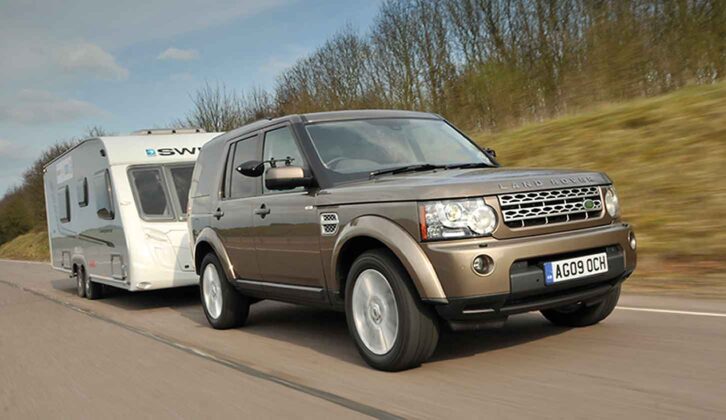
Land Rover Discovery 4
- Kerbweight: 2583kg
- Towing limit: 3500kg
- Towball limit: 150kg
- 85% match: 2196kg
Reason to buy:
- Plenty of room, highly efficient at towing
Reason to avoid:
- Layout and equipment feel dated, thirsty tow car
Offering plenty of cabin space and practicality, this seven-seater is a good used tow car to consider.
We like that there’s plenty of legroom and headroom throughout, even if you’re in the rearmost seats – opt to fold these down instead and you get a huge load area.
Touring as a couple? Then fold down the middle row of seats to benefit from a 2558-litre space, ideal for taking all of those heavy caravan essentials on tour with you. Our only complaint in here would be that we think its layout and the tech provided feel a bit dated.
There’s no avoiding that this is a thirsty tow car too, and reliability isn’t a given.
However, it provides direct steering. The 3.0-litre twin-turbocharged diesel engine is smooth and strong, working effortlessly with the automatic transmission. It’s comfortable when towing heavy tourers too – side winds are no problem, for instance. It takes hill starts in its stride, while traction is unwavering, even on a slippery surface.
Put all this together and it’s easy to see how our reviewer, Euan Doig, said “there are few finer tow cars than the Land Rover Discovery 4”.
Full review: Land Rover Discovery 4
How to choose the best used car for towing a caravan
Picking the right used tow car will enhance any towing experience, allowing you to enjoy a stable and reliable experience when you’re out on the road with your tourer. In contrast, the wrong model could result in an unstable and unenjoyable experience – the last thing anyone wants when towing a caravan.
The starting point will be the caravan you have, as you’ll need to ensure the used tow car you have in mind can legally pull your tourer. The two major caravanning clubs recommend abiding by the 85% guideline for safe towing – to work this out, take your caravan’s MTPLM, divide it by 85 and multiply it by 100 to work out the kerbweight you will need your car to provide
As an example, if your tourer has an MTPLM of 1350, divide it by 85, multiply it by 100, and you’ll get a kerb weight of 1588kg.
As well as this, you’d also have to make sure the legal towing limit is at least 1350kg.
After you know your tourer’s weight, you’ll be well on your way to finding a suitable used car for towing a caravan.
Do I want my used tow car to have 4WD?
Whether you want a four-wheel drive or not will, in many ways, come down to your touring habits.
For many, 4WD will be the right choice, particularly if you want to visit rural campsites and intend to tow a caravan in winter. Matching is also easier, as a 4WD will weigh more than a 2WD.
However, the counter consideration is that a 4WD will cost more and will also have worse fuel economy than a 2WD model. A 2WD car is also likely to be easier to find a pre-owned version of.
We’d say if you’re only planning to tow in the summer months and are intending to stay on hardstanding pitches, 2WD could be the way to go – otherwise, you may find it hard to justify the higher costs associated with a 4WD.
Should I pick a manual or automatic used car for towing a caravan?
Again, this comes down to personal choice. However, don’t make the mistake of assuming that the towing limits of a manual would be the same as the automatic version – it won’t necessarily follow. Take, for instance, the 2011- 2015 Honda Accord 2.2 i-DTEC manual, which comes with a legal towing limit of 1500kg – in comparison, the automatic offers 1100kg.
How we choose the best used cars for towing caravans
Since Practical Caravan launched in 1967, our expert team have carried out hundreds of tow car tests, encompassing everything from 4x4s and estate cars to SUVs and small crossovers. Heading to our tow car review section will let you see many of these.
Each vehicle in our guide will have been seen, tried and experienced by our experts, which puts us in a position to provide those qualities that are important when choosing a used car for towing a caravan.
These factors include the fuel economy provided, how well-suited it is to everyday use, whether it’s financially worth buying, the stability it provides, and, of course, its towing ability.
Combining this and then comparing the model with other towing options that have been tested puts us in an authoritative position to share the models that we think deserve to be in our best used car to tow a caravan guide.
Written with contributions from David Motton.
If you’ve enjoyed reading this article, why not get the latest news, reviews and features delivered direct to your door or inbox every month. Take advantage of our brilliant Practical Caravan magazine SUBSCRIBERS’ OFFER and SIGN UP TO OUR NEWSLETTER for regular weekly updates on all things caravan related.