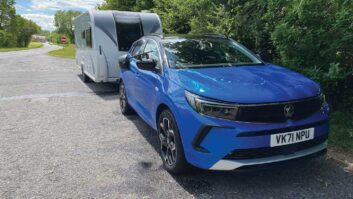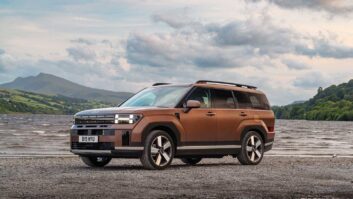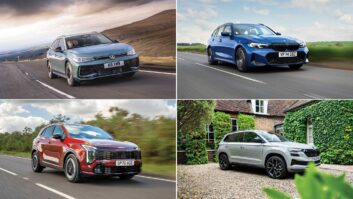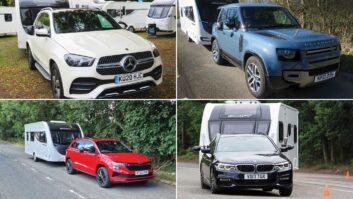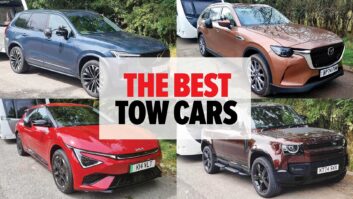
Most tow cars are quite middle-of-the-road. On any campsite, you’ll see a mixture of SUVs, estate cars and family hatchbacks.
There’s a good reason for that: these are the type of cars that tend to tow well while also handling the demands of everyday driving, two traits that will be crucial when looking for the best caravan tow car.
You don’t have to follow the herd when you’re choosing a tow car, however. With a little research, you can find a tow car that doesn’t fit the mould. Whether you want a more stylish option, a convertible, or a performance car, you may be surprised by some of the quirky tow cars that are approved for pulling a tourer. Don’t miss what I had to say about towing a caravan with a classic car, either.
Wind-in-the-hair tow cars
A surprising tow car is a convertible. There’s something rather incongruous about towing with the roof down, but some drop-tops are approved to tow.
A BMW 420i M Sport Convertible is not the kind of car you see towing a caravan very often. This four-seat convertible looks more at home on a sunny seafront than pulling a tourer. But with a kerbweight of 1765kg and a 184bhp engine, there’s enough power to quickly tow a mid-sized caravan up to speed. When it comes to matching a car to a caravan, you get a 85% match figure of 1500kg which is comfortably within the braked trailer towing capacity of 1600kg.
A price of £54,660 puts the car beyond reach for many of us, but what if you’re after a used car for towing a caravan? A pre-owned 4 Series Convertible is much more affordable. A 2017 BMW 435d xDrive Convertible has a kerbweight of 1925kg and a towing capacity of 1800kg. The punchy diesel engine has 313bhp and 343lb ft of torque, so it offers a big performance advantage over today’s petrol model. This version is four-wheel drive – handy if sunshine turns to showers.
We’ve found a 2017 435d Convertible with 42,000 miles on the clock advertised for £20,489. Higher mileage examples had prices around £14,000.
Should you decide you’d rather have a more standard towing option from the brand, you could always, of course, consider the BMW 530e M Sport Pro Touring instead.
Another option for sun-worshipping caravanners is the Range Rover Evoque Convertible. If you see one from a distance with the roof up you might mistake it for a regular 4×4, but no, this convertible SUV can lower its roof whenever the sun shines.
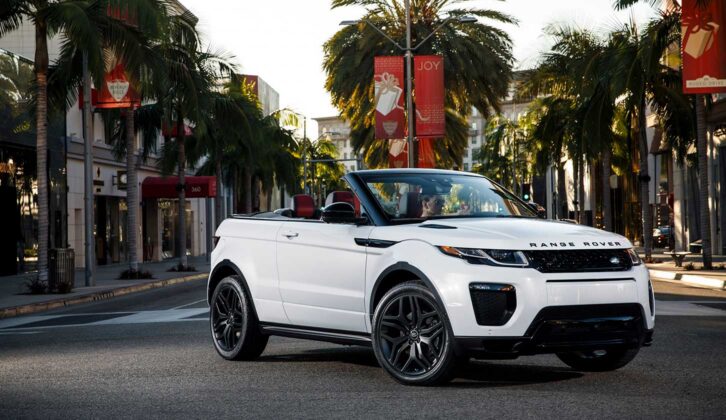
The strengthening required to keep the Evoque’s body rigid added lots of weight to the car, so kerbweights hover around the two-tonne mark depending on the exact model and specification. The towing capacity is 1500kg.
Sold between 2016 and 2018, these cars are now surprisingly affordable for those of you who are looking at buying a used tow car. Prices start from around £13,500. Low-mileage, high-spec examples cost around £18,000. If you are tempted, just make sure you keep a fighting fund to one side to stay on top of maintenance and any faults which may crop up.
The BMW and Range Rover drop-tops are unusual but not unique by any means. For example, the Audi A4 Convertible is approved for towing (although now out of production). The Volkswagen Eos (made from 2006-2016) was also approved for towing, with a capacity of up to 1500kg.
Performance tow cars
Towing with a high-performance car may seem rather self-indulgent, but it is possible if you know which models are approved for towing.
At the most ridiculous extreme, the BMW M5 is approved for towing. For fans of plug-in hybrid tow cars, this performance vehicle is sold as a saloon and an estate, with both versions having a 2000kg towing capacity. With 727bhp it will be far quicker than anyone needs it to be, and it can even pull a two-tonne caravan.
The price tag is a lofty £114,095, so the M5 will only be within reach of a few. The earlier E39 M5, sold from 1998-2003, is more affordable. Prices vary widely depending on mileage and condition but start from around £20,000 for high-mileage cars. Closer to £30,000 will buy a lower-mileage example with a full service history.
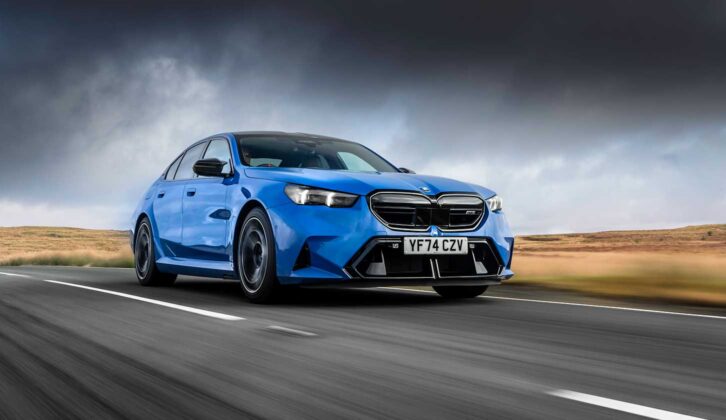
These V8 cars are wonderful to drive, although expensive to fuel, insure and maintain. The towing capacity is 1800kg. With a kerbweight of 1795kg, the 85% match figure is 1526kg.
If you prefer fast Audis, the likes of the high performance RS4 and RS6 models have been approved for towing, with limits of 1900kg and 2100kg for the most recent generations. These powerful estate cars have four-wheel drive and large boots, which almost qualifies them as sensible. Provided you can live with the enormous running costs, putting a 2021 car on your drive will cost upwards of £65,000.
If you are looking for a smaller performance car, the Ford Focus ST was approved for towing up to 1600kg. With a 1512kg kerbweight, a caravan weighing 1285kg makes a sensible match for this 280hp hatch.
It’s no longer in production, but 2023 cars start from around £23,000.
Head-turning tow cars
These powerful machines are all well and good, but nobody is allowed to tow at more than 60mph however quick the tow car. So, what about something less aggressive and much cuter to look at?
Volkswagen’s revival of the VW Beetle is the sort of car we have in mind. Sold between 1997 and 2011, some Beetle models are approved to tow up to 1000kg. That’s not an awful lot, but a teardrop caravan such as a Tab or a small Eriba would look great being pulled by a Beetle.
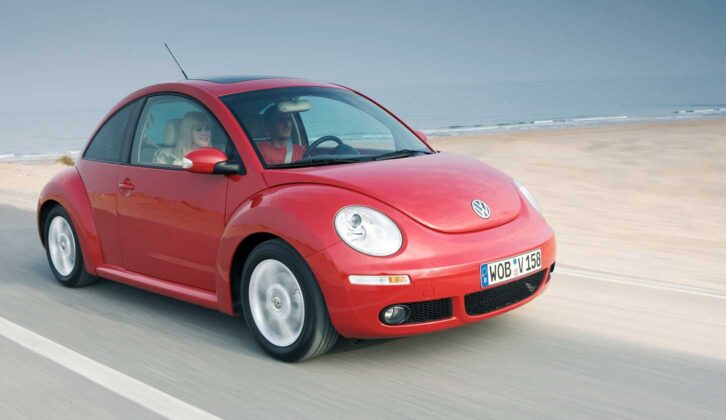
It is an ageing car, though, and unfortunately the newer Beetle that replaced it in 2011 wasn’t approved to tow.
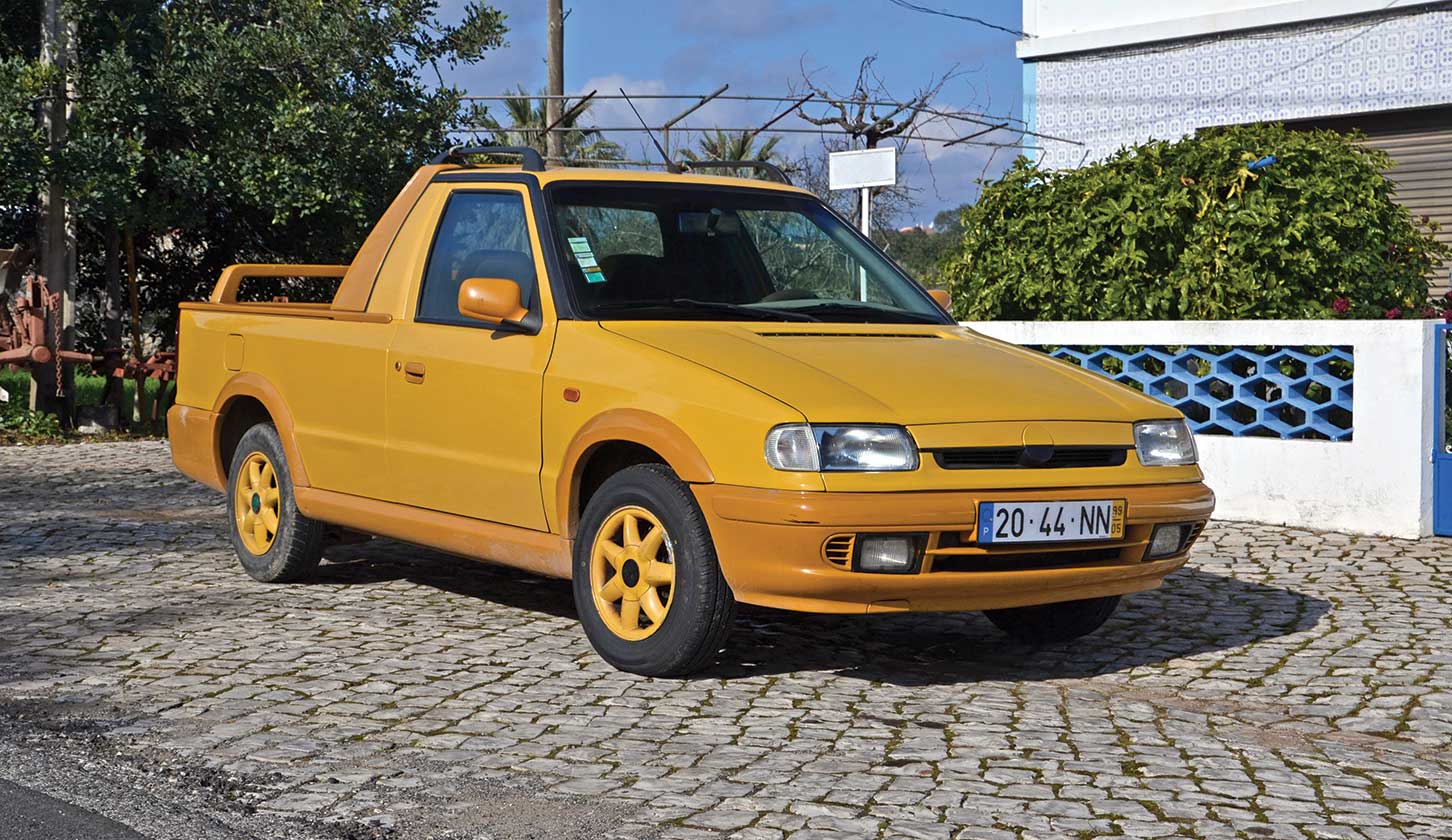
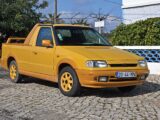
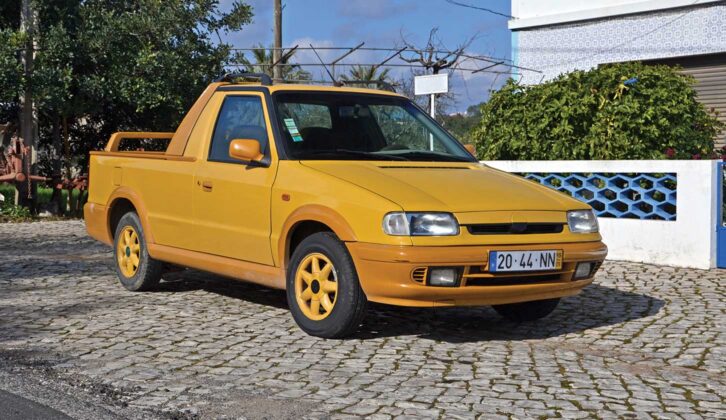
Another eye-catching tow car is the Skoda Felicia Fun. This oddball pick-up from the 1990s has a modest capacity of just 750kg, but you’d have more attention in the Skoda than in cars costing ten times as much. We found an example of this rare machine on sale for £7500.
Towing on two wheels
We’re stretching things a bit, but did you know you can actually tow a caravan behind a bicycle? Now that really would turn heads, and get you very fit!
The Wide Path Camper is made in Denmark. This ingenious design provides space for two to sleep and the makers say it can be set-up in three minutes.
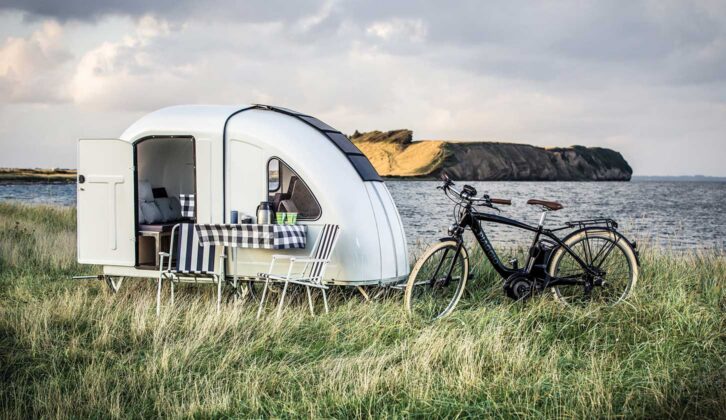
For €4699.99 (around £4000) this fold-out caravan can be towed behind most bicycles, although it surely makes most sense in countries with lots of cycling infrastructure and few hills! The wide range of electric bicycles would also add to its viability.
If, after all that, you have decided you would rather stick with a more middle-of-the-road car, take a look at my latest tow car review as I put the Škoda Enyaq 85x Sportline to the test, an EV which tows with stability, although battery range could be an issue. Alternatively, see what I thought about the Ford Ranger 2.3 PHEV Stormtrak, a capable pick-up, but one that is chunky in both size and price.
Lead image: Getty Images
If you’ve enjoyed reading this, why not get the latest news, reviews and features delivered direct to your door or inbox every month. Take advantage of our brilliant Practical Caravan magazine SUBSCRIBERS’ OFFER and SIGN UP TO OUR NEWSLETTER for regular weekly updates on all things caravan related.