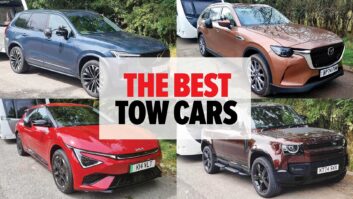

Caravanning is a little like a marriage. Your car and tourer are partners, and if the two don’t get along it can cause all sorts of trouble.
Your car needs to be a good match for your caravan, but there’s more to a happy motoring marriage than weights and measures. So how do you choose the best car for towing a caravan? Just how do you know if a car will be able to pull a tourer well? Follow these pointers, and you won’t go far wrong.
Match-making
Before we get into which features to look out for, let’s quickly cover the basics of matching a car to a caravan. Both major caravanning clubs recommend towing a caravan weighing no more than 85% of the kerbweight of the tow car.
So, when looking for a suitable towing vehicle, divide the Maximum Technically Permissible Laden Mass (MTPLM) of your caravan by 85, and multiply the result by 100 (take a look at our guide to caravan weights if you need to brush up on the various terms).
So, if you own a 1700kg caravan, ideally you are looking for a tow car weighing 2000kg or more (1700 divided by 85, multiplied by 100). Or perhaps you have a lightweight tourer, in which case one of the best small tow cars will be ideal.
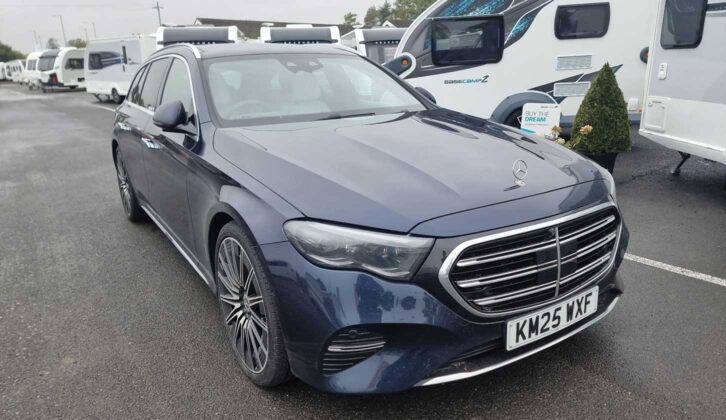
Take the Mercedes-Benz E 450 d 4Matic Exclusive Premium Plus Estate; it has a kerbweight of 2140kg and an 85% of kerbweight of 1819kg.
Matching ratios of up to 100% are acceptable if you are an experienced tow car driver, but abiding by the 85% guideline makes for more stable towing whatever your level of experience.
Next, check the towing capacity of the car. This will usually be above the 85% match figure, but not always. If it is below the MTPLM of your caravan then this model isn’t suitable for towing your van.
Check the maximum download on the towbar (AKA the noseweight). If the permitted download is 5-7% of the laden weight of your caravan, that’s a good sign.
Might and muscle
The matching ratio is important in gauging whether a car will be stable while towing a particular caravan. While that must be the first priority, performance also matters. An underpowered tow car will struggle to get up to speed and will be under strain on every hill.
Don’t worry too much about the engine’s capacity. Instead, look at the power (hp, PS, or bhp) and torque figures (lb ft or Nm). Torque (twisting force) is the more important of the two for towing. Think of engines with high power as racehorses, and engines with high torque as shire horses. You want a shire horse engine for towing.
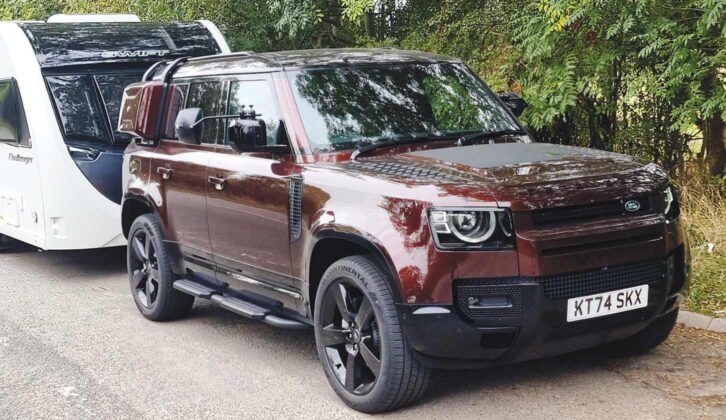
Take the Land Rover Defender 110 D350 Sedona Edition, which has an impressive torque of 536lb ft.
Diesel engines generally have more torque than the equivalent petrol engine and, as a rule, are better suited to towing. However, modern petrol engines often have enough torque to tow without undue strain, so the advantage of a diesel engine is much less pronounced than it used to be.
Petrol-electric hybrids use electric power which helps to compensate for the modest response of a petrol engine from low revs. Both full and plug-in hybrids can tow very well.
Electric tow cars generally have excellent power and torque figures. The more pressing issues related to towing with an EV relate to range and recharging rather than stability and performance.
Whatever type of powertrain you choose, a useful guide is to have 80lb ft of torque for every tonne of car and caravan. So, if the combined weight of car and caravan is three tonnes, then 240lb ft of torque should give good performance. A little less may be sufficient, but 80lb ft per tonne is a good target to aim for.
The driven wheels
Many caravanners go their whole towing lives without owning a four-wheel drive vehicle. Others would never tow with anything else.
Sending power to all four wheels makes for better traction. It also increases a car’s kerbweight, so one of the best 4x4s for towing a caravan will have more favourable matching ratios than its two-wheel-drive equivalent.
A 4×4 drive system is of most benefit if you’re a fan of caravanning in winter, especially if you stay on grass pitches. If you stay on hardstanding during the main touring season, four-wheel drive is not essential.
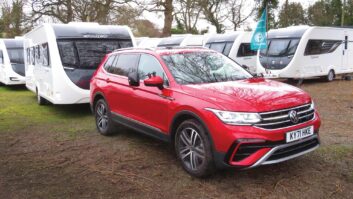
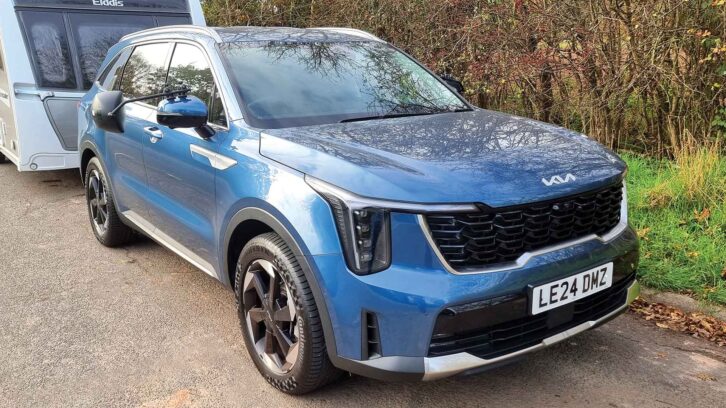
One 4×4 that impressed us when we tested it was the Kia Sorento 2.2 CRDi ‘3’ (pictured above), a vehicle which we thought provided an excellent towing experience.
Towing-friendly features
There are some features to look out for which improve tow car performance.
Go for a model with a trailer stability programme (TSP). Different manufacturers use a variety of names for this feature, but the word ‘trailer’ will be in there somewhere. TSP is a towing mode for the car’s stability system and uses the brakes to tackle any caravan snaking or side-to-side instability.
Self-levelling rear suspension is also beneficial. This stops the car from sitting down at the back when it’s heavily loaded. It’s an especially useful feature if the tow car is front-wheel drive, as a heavy load in the back can make it easy to spin the front wheels.
Several modern cars come with a driver aid called ‘Trailer Assist’ or similar. This makes for easier reversing, as it does away with the need to turn the steering wheel in what instinctively seems to be the wrong direction. It’s nice to have but won’t see much use if your tourer has been fitted with a motor mover, a gadget that our contributor, John Sootheran, picked out as one of his favourite caravan upgrades.
Nice, but not essential
There are a few characteristics and features that help make towing easier but aren’t necessarily deal-breakers.
A good quality reversing camera is hugely useful when hitching up a caravan on your own, and it’s helpful even if you have someone to guide you.
Go back 15 or 20 years and many cars had full-sized spare wheels, or a proper spare could be ordered as an option. These days full-sized spares are rare, and some cars don’t even have the option of a space-saver wheel. If carrying a proper spare rather than relying on a tyre repair kit is important to you, remember to check the specification before you buy.
Conclusion
Most modern cars make respectable vehicles for towing a caravan, so long as they are matched sensibly and the towing capacity isn’t exceeded. A healthy matching ratio and plenty of pulling power are the foundations of a good tow car.
If you’ve enjoyed reading this article, why not get the latest news, reviews and features delivered direct to your door or inbox every month. Take advantage of our brilliant Practical Caravan magazine SUBSCRIBERS’ OFFER and SIGN UP TO OUR NEWSLETTER for regular weekly updates on all things caravan related.