Few topics inspire such strong opinions as towing with an electric vehicle (EV). Contrary to what some would have you believe, it is possible to tour with an EV, as the best electric tow cars show.
Electric cars for towing will generally come with high power and torque, typically offering excellent stability and acceleration, which are always welcome traits when choosing good caravan tow cars. But we can’t pretend towing with an EV is as convenient as it is with a car powered by an internal combustion engine. Range is a sticking point, but not the biggest. Yes, you’ll run low on charge every couple of hours, but it’s best to take a break every two hours anyway.
The real trouble is how to charge an EV while towing, as it will generally see you using charging points designed for vehicles without a caravan. As a result, you’d need to find a suitable spot to park your tourer, taking care to have appropriate security accessories such as the best caravan hitchlock to keep it secure while you top up your EV battery. This can be tackled with planning and patience.
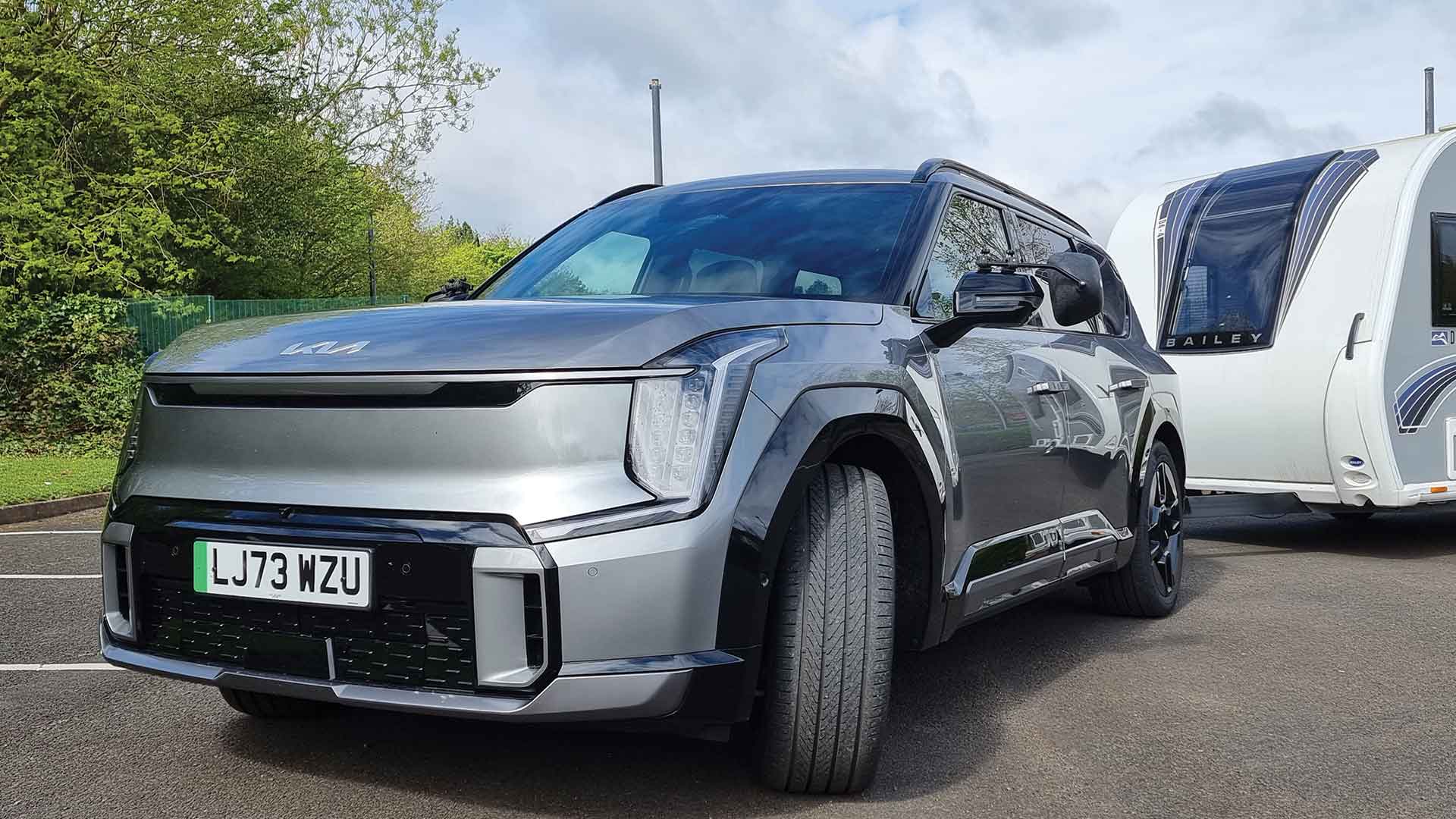
If you are keen to go for an EV, these are our picks for the best electric tow cars. In 2026, the Kia EV9 GT-Line still remains our favourite EV to tow a caravan with, a car which offers excellent stability and one that we have shortlisted at the 2026 and 2025 Practical Caravan Awards.
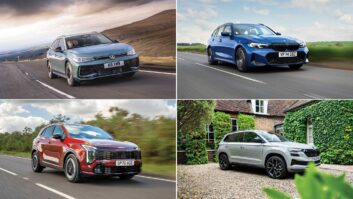
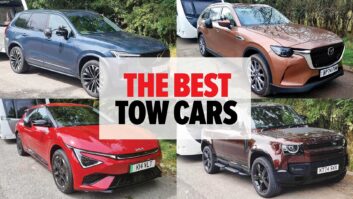
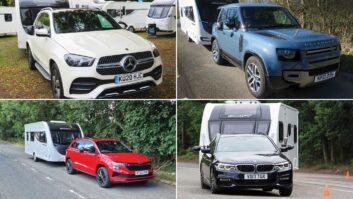
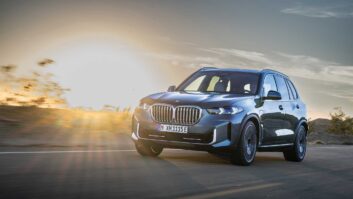
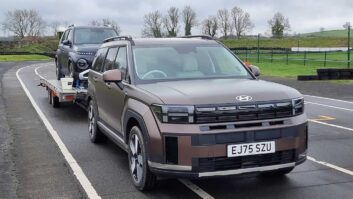
Vehicles pictured may not be exact model or year
The best electric car for towing
Kia EV9 GT-Line AWD
Polestar 3 Long Range Dual Motor
Kia EV6 GT-Line AWD
Hyundai Ioniq 6 Ultimate AWD
Volkswagen ID. Buzz Style 5st
BMW i4 eDrive 40 M Sport
Tesla Model Y Long Range AWD
The best electric tow car
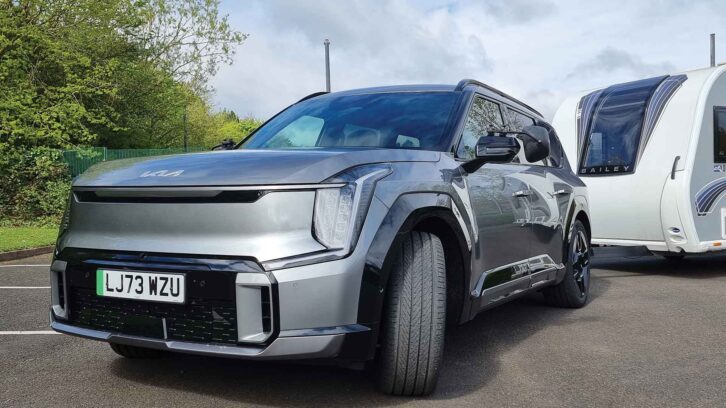
Kia EV9 GT-Line AWD
- Price: £73,985
- Kerbweight: 2664kg
- 85% match: 2264kg
- Towing limit: 2500kg
The EV9 remains the best electric car we’ve towed with. The list of reasons is a long one, in an EV that has been shortlisted at both the Practical Caravan Awards 2026 and Practical Caravan Awards 2025 for our best tow car for a 2000kg caravan category.
For starters, the EV9 is heavy, weighing well over 2.5 tonnes. This means even very heavy caravans weigh much less than the Kia, so there’s almost no chance of the tail wagging the dog.
Another reason is the vehicle’s 2500kg towing limit. That’s exceptionally high for an EV and means experienced drivers happy to tow above the 85% guideline won’t feel restricted.
Then there’s the power of the twin motors, with 378bhp. In solo driving, the EV9 is effortlessly quick, and when pulling a caravan, it can overtake confidently.
Four-wheel drive also means that you can make the most of its acceleration with no wheelspin, even when the roads are greasy. Stability is excellent, whether you are towing on the motorway or a twisting country road.
Inside, the EV9 is very practical. Perhaps it’s not as plush as some upmarket alternatives, but there’s definitely ample space for seven to travel in comfort.
The Kia is still quite a new model, so as yet, there aren’t huge numbers of used examples on forecourts. We’ve seen a 5000-mile 24-reg car priced at £59,950.
Full review: Kia EV9 GT-Line AWD
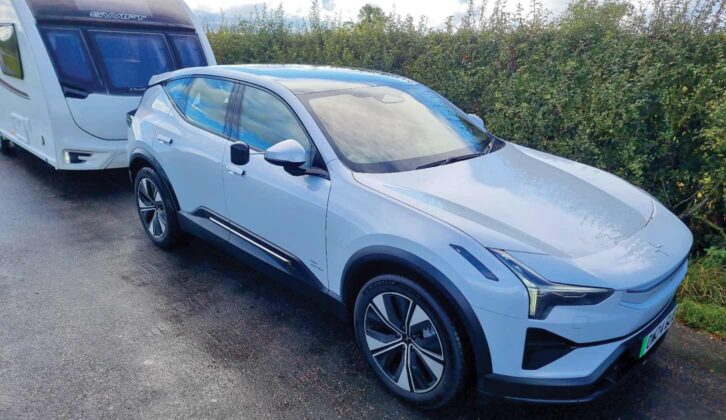
Polestar 3 Long Range Dual Motor
- Price: £75,910
- Kerbweight: 2579kg
- 85% of kerbweight: 2192kg
- Towing limit: 2200kg
The Polestar 3 Long Range Dual Motor is undoubtedly a luxury SUV, and an electric tow car which combines a heavy kerbweight of 2579kg with an approved towing capacity of 2200kg, something which isn’t always seen in an EV.
The Polestar is not short on pulling power either, with an impressive 620lb ft of torque, which, when combined with its weight and four-wheel drive, points to its towing ability.
We matched it to a tourer with a MiRO of 1419kg and found the 3 towed very well. Our tester thought it accelerated more quickly while towing than some cars manage when driven solo. The gearbox also responds smoothly, and maintaining speed on hilly roads is straightforward. In fact, we’d even suggest keeping an eye on the speed dial to make sure you’re not inadvertently going faster than you might expect.
The EV tows well on the motorway too, and we liked how little movement was felt in crosswinds or around high-sided vehicles. Towing in damp conditions was well within the Polestar’s capability, too.
Ok, all positive so far. We do have a couple of gripes, however. This is because of its frameless door mirrors, which means conventional towing mirrors have nowhere to clamp onto. The touchscreen makes doing everyday jobs a little fiddly at times, too.
Despite this, our reviewer remarked “the 3 handles with poise and agility”, which is impressive considering its size and weight. We did think the visibility over-shoulder wasn’t great, but this isn’t too much of an issue, as you get good all-round cameras, as well as sensors when you’re parking up.
We also liked the minimal design in the cabin. For some, it could be on the austere side of things, but we thought it was stylish. The interior is spacious too, with plenty of room in both the front and back, as well as a boot space of 484 litres.
The car has an official range of 390 miles and recharges at a rate of up to 250 kW. When we tested it, we achieved 1.667 miles per kW, so a range of 178 miles.
Full review: Polestar 3 Long Range Dual Motor
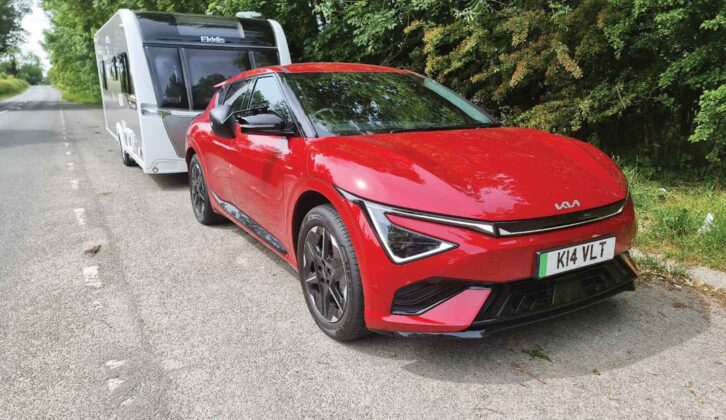
Kia EV6 GT-Line AWD
- Price: £52,085
- Kerbweight: 2150kg
- 85% of kerbweight: Above max tow
- Towing limit: 1800kg
Our tow car tester remarked that the updates made to the EV6 made “one of the best EVs even better”.
It’s one of our favourite electric cars for towing, with the updated model coming with a bigger battery and an improved towing capacity. The latter can sometimes be a problem with EVs, but we don’t think that can be levelled at the Kia, which has gone from being approved to tow up to 1600kg to 1800kg.
We paired it to a tourer with a MiRO of 1373kg and were quickly up to speed. In fact, it reached 60mph without showing any signs of effort.
As an all-wheel drive, the EV6 comes with a motor for each axle and offers a combined output of 320bhp, as well as 446 lb ft of torque. The gearbox moves smoothly when switching down to a lower gear, and while there may be quicker EVs on the market, we found it perfectly capable of quickly overtaking with confidence when towing a tourer.
Stability was also impressive, with only the smallest of movements when driving around HGVs or in crosswinds. Suspension is more on the sporty side, but we found it comfortable, and hill starts also proved straightforward.
Like the Polestar, there is not amazing rear visibility, but a rear-view camera gets around this. We also thought the EV6 was a great everyday car to use, too.
The first thing you’re likely to notice inside will be the digital display and the touchscreen, which are found on the dashboard, with the former nice and clear, while the latter is simple to use. There’s plenty of room to sit, both up front and in the back, while a boot space of 490-1300 litres is perfectly adequate.
Thanks to its improved battery, it can achieve a range of 339 miles, and when towing, this was more like 140 miles.
Full review: Kia EV6 GT-Line AWD
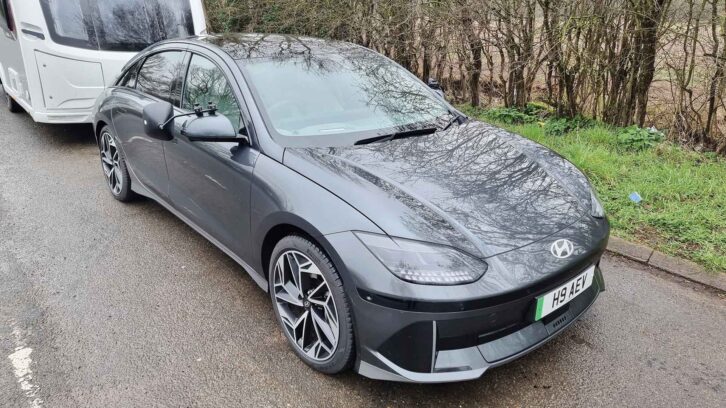
Hyundai Ioniq 6 Ultimate AWD
- Price: £54,040
- Kerbweight: 2095kg*
- 85% match: Above towing limit
- Towing limit: 1500kg
*Includes 75kg for the driver not included in Hyundai’s kerbweight
Hyundai’s electric four-door follows a similar formula to the BMW i4, but with a much lower price. And despite its coupé style sloping roofline, the Ioniq 6 is surprisingly practical.
The range-topping model has four-wheel drive. Whether or not the owner plans to tow, we think it makes sense to choose the AWD car to put the Ioniq 6’s 325hp to the road cleanly.
The Ioniq 6 is quick when you want it to be, but smooth and easy to drive when you’d rather just cruise.
With a caravan in tow, the Hyundai is stable and sure to inspire confidence. There are some very slight movements around HGVs or in strong winds, but otherwise, the Ioniq 6 tracks straight and true.
Being compatible with 350kW chargers makes for quick stops on long journeys. If you can find a powerful enough charger, a 10-80% charge needs just 18 minutes.
Officially, a full charge is good for up to 322 miles in solo driving. While towing a 1400kg caravan with the Ioniq 6, we achieved a range of 126 miles.
If you like the Hyundai’s mix of style and performance, but not the price tag, there’s a reasonable choice of used cars available. Prices start from just over £26,000 – check out where to buy a used tow car for more on choosing the right place to purchase from.
Full review: Hyundai Ioniq 6 Ultimate AWD
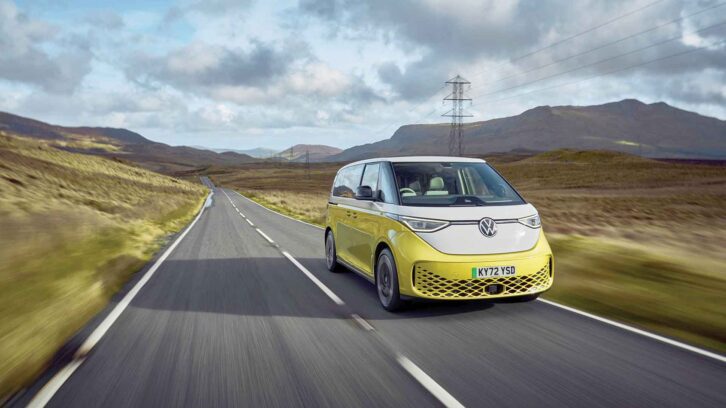
Volkswagen ID. Buzz Style 5st
- Price: £63,835
- Kerbweight: 2492kg
- 85% match: Above towing limit
- Towing limit: 1200kg
It’s pretty difficult to look at this vehicle without smiling. Volkswagen’s retro-futuristic styling really stands out.
But when it comes to matching a car to a caravan, the maximum towing figure may wipe the grin from your face. Being limited to 1200kg rules out most full-size caravans, which is frustrating for such a large, heavy car.
The high-powered GTX four-wheel drive costs a lot more, but has a better 1800kg maximum towing figure.
There’s plenty of space inside for people, even if they will be squeezing into a small caravan at journey’s end. We’ve picked the five-seat version as that’s the one we’ve driven, although we suspect the new seven-seat model is even better.
Being so heavy and having 286hp, the Buzz tows light caravans with ease. There’s plenty of punch for overtaking, and stability is excellent. You’d think the car could handle a much heavier caravan.
Inside, the cabin could be better finished for a £60,000 car and the seating arrangement isn’t especially flexible for an MPV. That said, there’s plenty of space for five people and
lots of luggage room.
Compared with many EVs, the ID. Buzz holds its value well. We’ve seen used 2022 examples with around 20,000 miles on the clock priced at about £40,000.
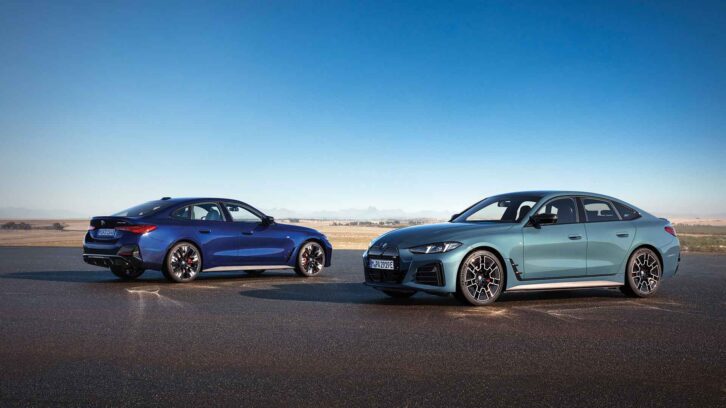
BMW i4 eDrive 40 M Sport
- Price: £60,865
- Kerbweight: 2125kg
- 85% match: Above towing limit
- Max towing weight 1600kg
It’s not the most practical tow car, but the BMW i4 really is exceptionally strong and stable.
With 340hp, the eDrive 40 M Sport has a 0-62mph time of 5.6 seconds in solo driving.
While towing, that translates into effortless speed, holding pace comfortably on steep hills and reaching the speed limit when towing a caravan of 60mph well before the end of a motorway sliproad.
While punchy acceleration is a nice quality for a tow car to have, stability is absolutely essential. The i4 excels in this respect. It’s very heavy indeed, but as a four-door coupé, it carries all that weight closer to the ground than electric SUVs. That makes for superb towing manners, even when the wind does decide to pick up.
In daily driving, the i4 is quiet and comfortable, with far less noise at speed than you’ll hear in a Tesla Model Y. The hefty weight does blunt the BMW’s agility on a twisty road, but you would definitely need to be pressing on to notice that.
More likely, you’ll consider the back of the car a bit too cramped, or the price a little high compared with roomier alternatives. The price will be much lower if you let someone else take the first hit of the depreciation. We spotted a 22-plate car with 28,000 miles on the clock for £29,949.
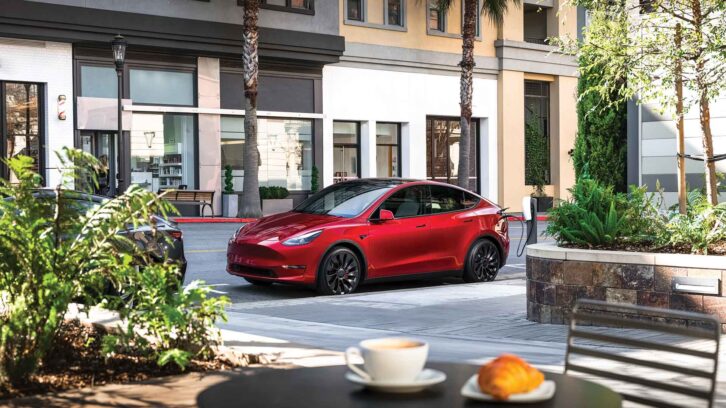
Tesla Model Y Long Range AWD
- Price: £51,990
- Kerbweight: 1979kg
- 85% match: Above towing limit
- Towing limit: 1600kg
In our opinion there are better EVs than the Model Y, but any Tesla has a big advantage over its rivals – the Tesla Supercharger network.
With a few exceptions, these plentiful, reliable and powerful chargers are reserved for Tesla owners’ use only.
You’ll need to find somewhere secure to leave your van while you charge, but for some drivers, the Supercharger network is reason enough to go for a Tesla.
The Model Y is Tesla’s most caravan-friendly vehicle, with a usefully high maximum towing capacity of 1600kg. That’s a little less than the 85% match figure, but still enough for a wide range of tourers to make sensible matches.
Performance is strong, even while towing, and if you choose the four-wheel-drive version, the Model Y is a very capable all-season tow car, making it a good option for those who like towing a caravan in winter.
Stability is good, but the likes of the BMW i4 and Kia EV6 are more secure if forced to change lanes in a hurry. The Tesla is also quite rowdy for an EV, with lots of wind and road noise.
Inside, the button-phobic design forces you to use the touchscreen for simple tasks, but there is lots of space for people and luggage.
Used prices for the Model Y start from around £25,000.
If you’re not quite sure whether an EV is the right type of towing option for you, take a look at what I had to say about the hybrid vs plug-in hybrid vs electric debate.
If you’ve enjoyed reading this article, why not get the latest news, reviews and features delivered direct to your door or inbox every month. Take advantage of our brilliant Practical Caravan magazine SUBSCRIBERS’ OFFER and SIGN UP TO OUR NEWSLETTER for regular weekly updates on all things caravan related.