Whether it’s for the LED lights, the heating or the toilet flush, you will quickly find not much is going to work in a modern caravan without electricity.
While gas hobs can be manually lit, gas heating cannot work without electrical power either, as it is needed to ignite the flame and operate the blown-air fan. So, what does this mean for those who are caravanning off-grid? What can be done to ensure you still have as much battery and mains power as you want, wherever you pitch up?
The good news is that there are a variety of products out there that will help. Here, I’m explaining how to power a caravan off-grid.
How to power a caravan off-grid
Going off-grid
Battery banks
Battery-to-battery charger
Solar panels
Inverters and inverter chargers
Power stations and power banks
Consume less with new gadgets
Powering a caravan off-grid
Going off-grid
A lot of power will be required if you’re intending to air-condition or heat your caravan, as well as cook meals, using only the batteries. This can generally be done either by increasing your battery bank’s size or adding a more powerful charging system, caravan solar panels, and an inverter. Or even, if you’re so inclined, a combination of the above.
To work out how long your battery bank would last with your usage, there are a number of calculators that can be found online. While usage can differ, you can generally assume that a lot of power will be needed if it heats, cools, or operates with a motor.
One such example is a microwave oven, because it comes with a high voltage, heats up, and also needs power for the turntable.
Battery banks
You will find you’re limited if you’re intending to use a single battery and find yourself staying overnight without using electric hook-up with the caravan.
The simplest way to achieve more power, even if you have the best caravan leisure battery, would be to add a second one. We’d advise sticking to two identical batteries in terms of the brand, age, capacity and chemistry, as opposed to adding a random new battery to your existing one.
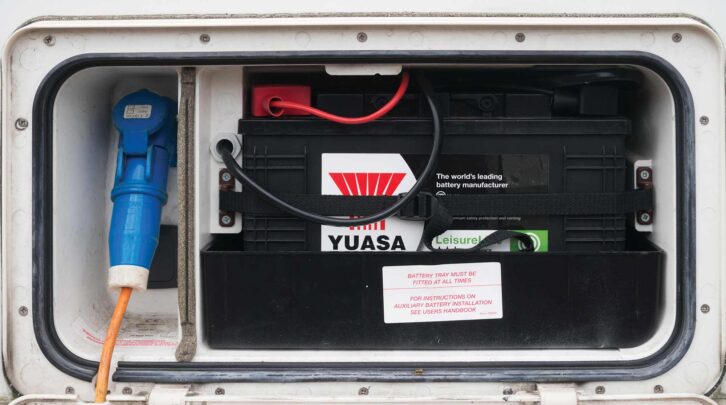
The majority of caravans should have the provision for a second battery, and will possibly even have the wiring in place. However, if there is no wiring where it’s required, any additional batteries will need to be fused close to the battery terminals.
Any electrical item added to your battery will need to be fused, as otherwise, the wiring loom acts as fuse, which can ignite should an electrical fault occur. Fuses are not optional.
If you’re not sure which size to choose, our guide to what size leisure battery do I need for a caravan will help too.
Battery-to-battery charger
Once you’ve added to the capacity of your battery, a battery-to-battery charger (B2B), such as the EcoFlow Alternator Charger, will be the next crucial item to get for off-gridding. It uses the power from your tow car’s alternator and pushes a lot more current into the leisure battery than you would achieve during normal towing.
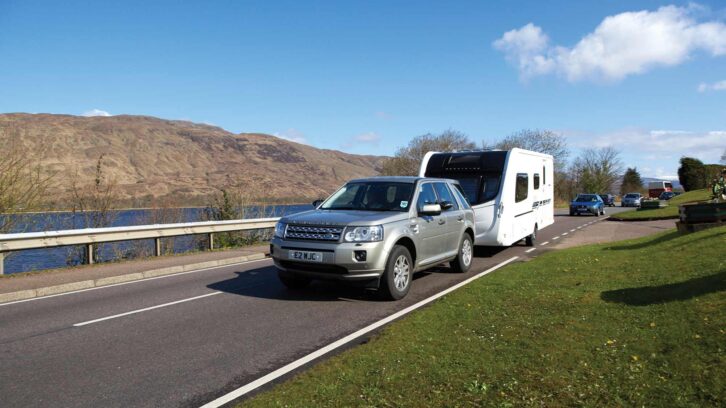
In some cases, caravanners have even been able to stop paying for hook-up after adding a B2B charger, so for an off-gridder, it’s essential.
Solar panels
Installing caravan solar panels will make a big difference. Opt for the largest capacity that can fit on the roof of your tourer (not forgetting to factor in your payload), before wiring it to the batteries with a suitable regulator and a fused supply.
During the summer months, you will find your solar panels will be able to keep your batteries charged and operate a variety of gadgets for ages. Once you have them, they will operate automatically and very much fall into the fit-and-forget category.
However, it’s worth remembering that there are certain limitations. If you’re in the shade, performance will suffer, for instance.
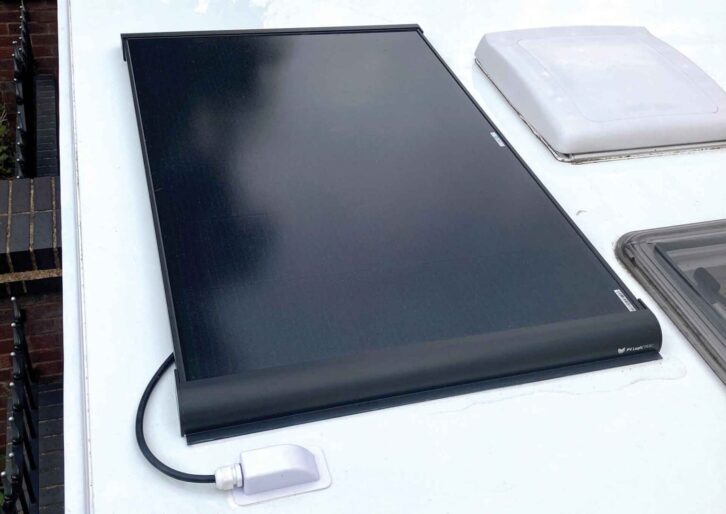
Output will also be significantly reduced if you’re caravanning in winter, when there is low sun and the solar panel is not angled appropriately. We’re sure we don’t need to tell you it will be nearly impossible to angle a tourer’s roof to 45 degrees!
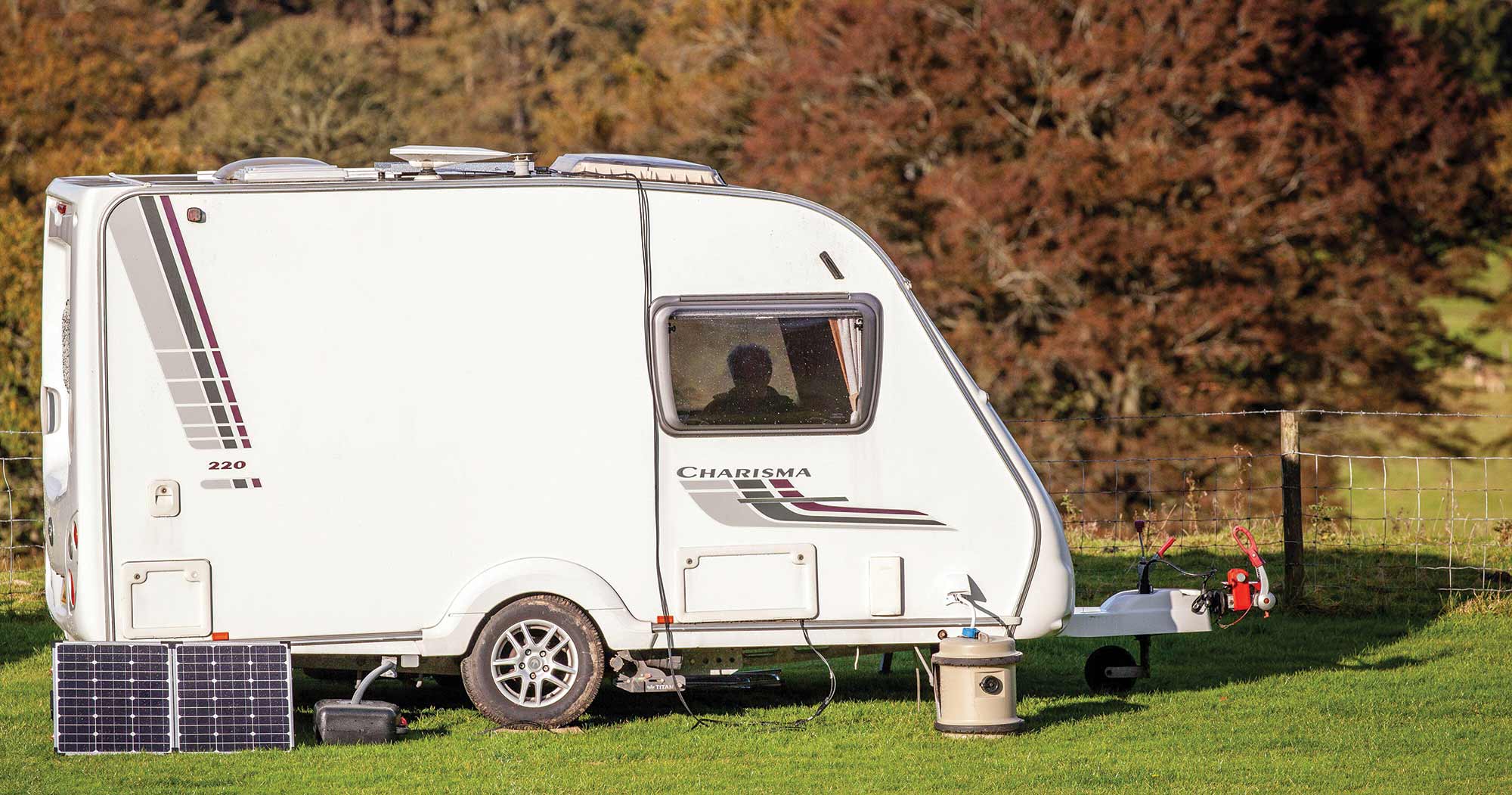
You’re going to need to know what size solar panel to get for a caravan, too. We’d advise a 150W solar panel as a starting point, and don’t feel you have to choose a roof-mounted option either. Fold-up panels can be connected to your leisure battery after you’ve pitched up at your site, and with these, you have the benefit of being able to angle them towards the sun.
Just make sure you check your caravan’s payload for the weight of any panels before buying them.
Inverters and inverter chargers
What about using a mains-powered device when you’re not plugged into electric hook-up? The good news is that this is possible, so long as you have an inverter. These are able to convert 12V DC battery power into 230V AC power.
One thing to be aware of is that some of this energy will be lost during the conversion (generally, this is around 20%), and if devices with a high power are being used (anything over 1000W), a huge amount of current will be consumed.
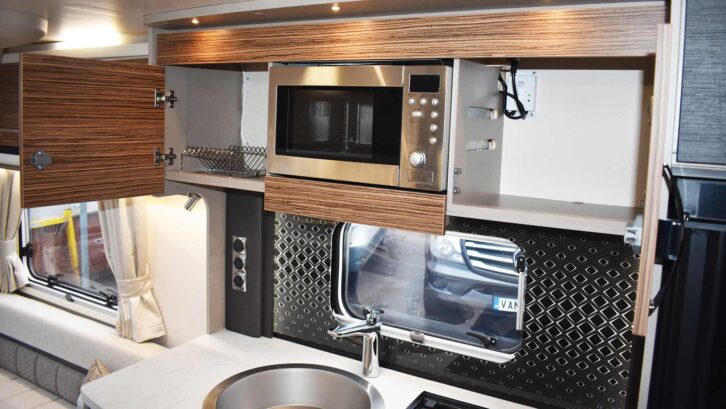
Two of the heaviest consumers you could operate through an inverter would be a microwave and a fan heater. For example, a 2500W fan heater would be consuming over 200A from a battery, which would flatten a 200Ah battery in less than an hour. We’d subsequently advise only using these occasionally, if at all.
The lower the wattage of a 230V item, the longer it can be run off an inverter. This is why it’s always worth having 12V-specific items, such as the best caravan kettle and toaster, so your domestic gadgets can stay at home.
Power stations and power banks
Power stations are quite a recent trend, and there are a variety of makes to choose from, including the likes of Ecoflow, Jackery and Anker. However, whichever manufacturer you opt for, you will find they’re broadly similar when it comes to performance and build.
Each one generally comes with a battery, an inverter, a selection of mains and USB outlets, and the charger. In some cases, you will find you have the option of buying a dedicated solar panel package, which provides a useful way of keeping the battery charged.
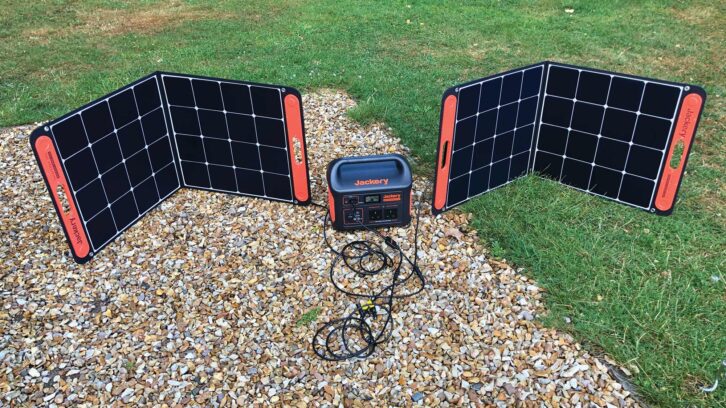
A particular benefit of a power station is that there are no costs involved to install one, and usefully, no fiddly wiring either. For those of you who don’t want to embark on any DIY or pay to have something fitted, a portable power station will be the solution, providing a useful way of achieving off-grid mains power.
For added versatility, they are portable too, so could easily be moved from your tourer to your awning. They can also be used to cook outdoors, as they can power an air fryer without running the risk of flattening the leisure battery.
When it comes to choosing one, work out what will suit your usage requirements. However, bear in mind that the larger the capacity, the heavier they become. My one, for instance, is the Ecoflow Delta Max, and that weighs 12kg.
Consume less with new gadgets
The majority of modern electrical gadgets are built to operate efficiently and have low energy usage. It pays to shop around for the most energy-efficient gadgets you can find, as well as upgrading your charging systems and battery. Keep an eye out for low-energy kettles and toasters, checking the label on the base of the product to identify what its input energy consumption is – the lower it is, the better.
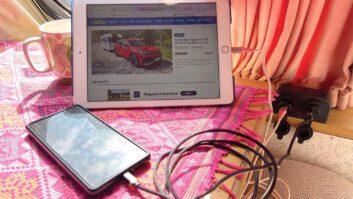
If you are heading off-grid and want to know what can be done to keep your phone topped up, a useful project to try is this one from Nigel Donnelly, where he carried out some DIY for charging phones in a caravan.
Lead image: Alamy
Future Publishing Limited, the publisher of Practical Caravan, provides the information in this article in good faith and makes no representation as to its completeness or accuracy. Individuals carrying out the instructions do so at their own risk and must exercise their independent judgement in determining the appropriateness of the advice to their circumstances and skill level. Individuals should take appropriate safety precautions and be aware of the risk of electrocution when dealing with electrical products. To the fullest extent permitted by law, neither Future nor its employees or agents shall have any liability in connection with the use of this information. You should check that any van warranty will not be affected before proceeding with DIY projects.
If you enjoyed reading this article, why not get the latest news, reviews and features delivered to your door or inbox every month? Take advantage of our brilliant Practical Caravan SUBSCRIBERS’ OFFER and SIGN UP TO OUR NEWSLETTER for regular weekly updates on all things caravan related.