

After arriving at a campsite, especially after a long journey, one of the last things the majority of us will want to do is have an intense upper body workout involving a spirit level. This felt like something of an inevitability at one point, but caravan self-levelling systems are taking the effort out of pitching up.
Understanding caravan self-levelling systems
Why does a caravan need to be level?
What does automated caravan levelling do?
How does self-levelling work
Can I level a caravan with steadies?
Who manufactures self-levelling systems for caravans?
Why does a caravan need to be level?
So firstly, why does levelling a caravan even matter? Well, unless you’re happy to shower in a cubicle which is unable to drain, it’s going to be crucial.
It can be an important part of ensuring caravan fridges are working as they should, as well as impacting how well you sleep, potentially leading to awkward positions (if you do need to improve your on-tour rest, don’t miss our tips on how to make a caravan bed more comfortable, either).
Before technology became involved, levelling often required using the best caravan levelling ramps and cranking the jockey wheel up or down; only then could you lower all four pesky corner steadies. Along the way you likely discovered muscles that you didn’t even know that you had. The ramps would be among the essential caravan accessories you needed for a tour.
None of it is that difficult, to be fair, but it definitely falls into the category of ‘chore’, and it was always noticeable that the children dashed off to ‘explore the campsite’ before I could requisition some child labour for winding duties.
What does automated caravan levelling do?
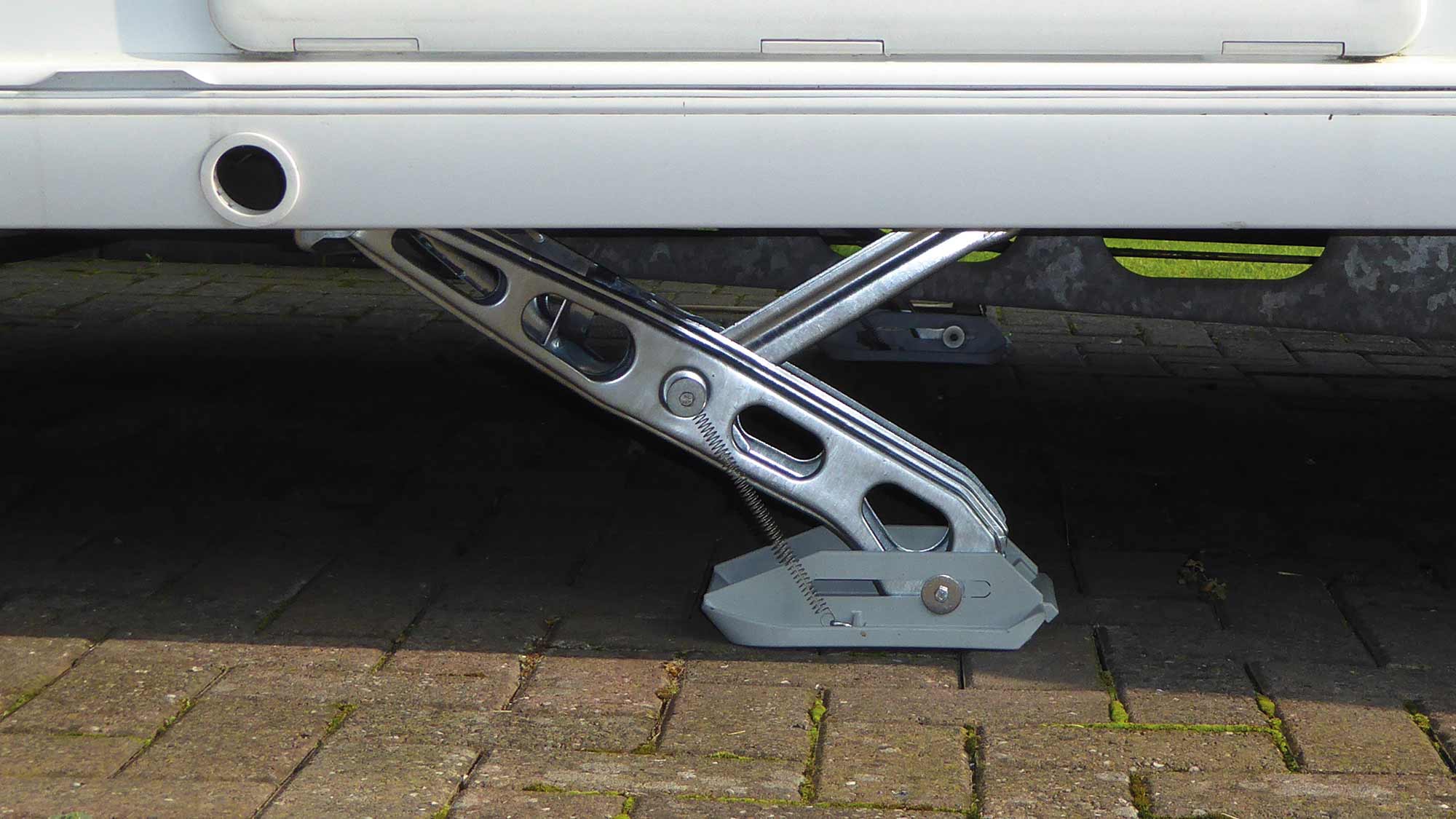
This is where caravan self-levelling systems will come into their own. This is an upgrade that uses gyroscopic technology to judge the caravan’s stance while it’s on the ground, and then sees the computer brain activate the hydraulic rams that are attached to your tourer’s chassis.
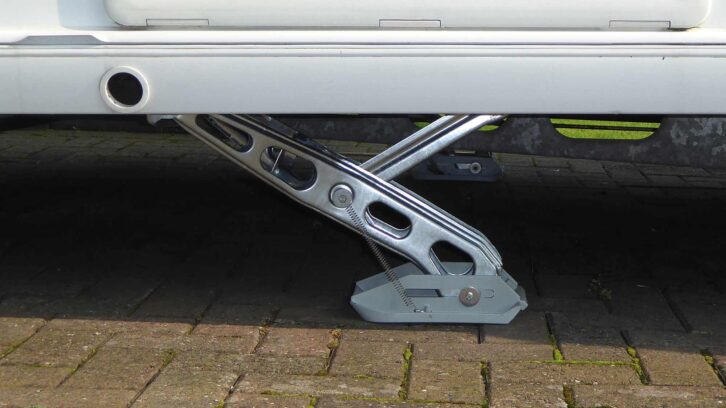
These will then drop down, lifting the tourer until it is 100% level, both laterally and longitudinally. The corner steadies then drop down to support the tourer in its new, level position. How’s that for a more relaxing start to a stay at one of the UK’s best caravan parks?
Something to remember though: you’ll need to factor the weight of the system into your tourer’s payload (and you can brush up on the various measurements you need to know about in our guide to caravan weights).
How does self-levelling work?
There are various companies in the UK offering this tech now, with each system working in a fairly similar way.
This involves using computer-controlled hydraulic power to achieve a level tourer, although the detail of how it’s achieved could differ.
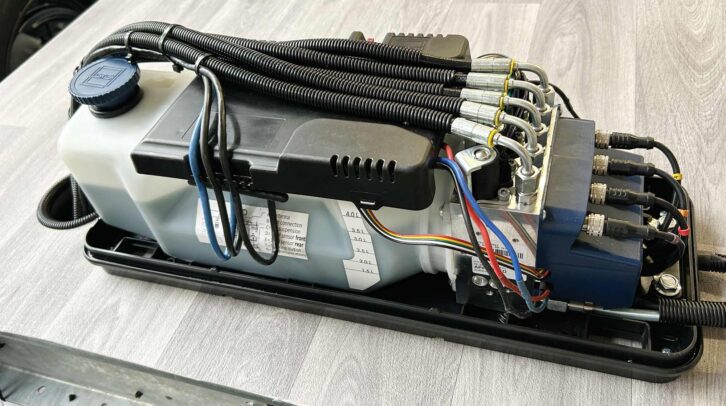
As a general rule, a control unit sits in a protective case, typically underneath the caravan. This case could contain a hydraulic liquid reservoir, a pump and a series of computer-controlled valves that regulate the flow of hydraulic liquid to the rams and the steadies.
Users simply apply the handbrake and raise the jockey wheel (lowering the front of the caravan).
Then, the caravanner will be able to use either a remote control handset, an app or the fixed control panel (normally found in a side locker) to initiate the system and press the ‘Start’ button.
A typical set-up comprises two hydraulic axle jacks, which are usually fitted to the axle near the wheels, and four hydraulic corner steadies, one at each corner of the chassis. Once activated, the axle jacks extend first, to lift and level the caravan side-to-side. Then the corner steadies deploy to stabilise and fine-tune the front-to-back level.
There is a central control unit that will be in charge of the entire process, with pressure sensors and angle monitoring used to ensure the caravan is completely level.
It’s a fast and automatic process, generally taking less than two minutes, and relies on a 12V battery to operate, with hydraulic fluid used so the rams can be moved precisely.
You then have a completely level tourer, saving yourself from having to use ramps, chocks, or guessing.
Some manufacturers offer a basic system, where the caravan will be levelled side-to-side automatically with rams, but end-to-end levelling is done manually with the jockey wheel, after which the corner steadies can be deployed.
Can I level a caravan with steadies?
Caravan corner steadies are designed to stabilise, not level, your tourer.
Their sole purpose is to keep a caravan steady once it’s already been levelled using rams or the jockey wheel. It is tempting to tweak the level by winding a corner steady a little further, but don’t; it’s among the caravanning mistakes you will not want to make.
Applying extra pressure in this way can twist the chassis and lead to serious damage, including cracked floors, split sealant, delaminated floor panels or even separated body joints. Only use corner steadies to stop the van rocking, never to lift or level it. Your caravan and wallet will thank you for it!
Who manufactures self-levelling systems for caravans?
Caralevel
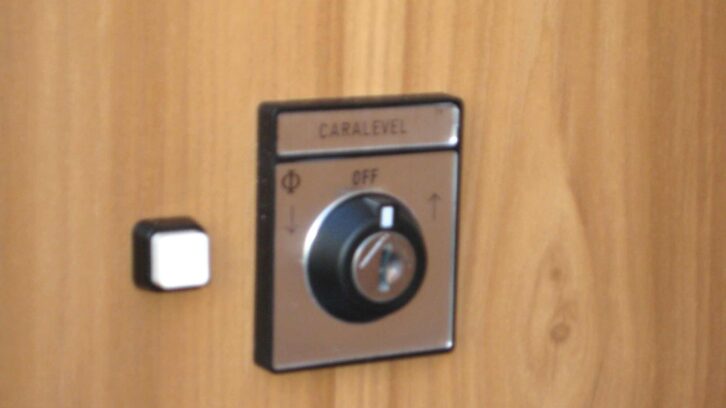
UK brand Caralevel offers a fully automated electric levelling system for caravans, operating at the turn of a key. It uses four steel legs, each capable of lifting up to 1250kg. The 12V system levels the van in under three minutes, and features built-in safety limits, a low power draw and diagnostic indicators. Caralevel is transferable between compatible caravans (useful if you’re buying a new caravan) and adds 20-25kg in weight.

Designed and supported in the UK, Caralevel is ideal for owners seeking hands-free levelling and more stability, without the need for using apps or remote controls. The company also offers Caralift, a bolt-on system designed to make it much easier to fit Al-Ko wheel locks on twin-axle caravans.
E&P Hydraulics
E&P Hydraulics’ flagship system, Level C, includes two hydraulic axle jacks and four hydraulic corner steadies, delivering full levelling and stabilisation in less than two minutes. Level C Compact is the lightweight alternative, with two hydraulic axle jacks for automatic side-to-side levelling.
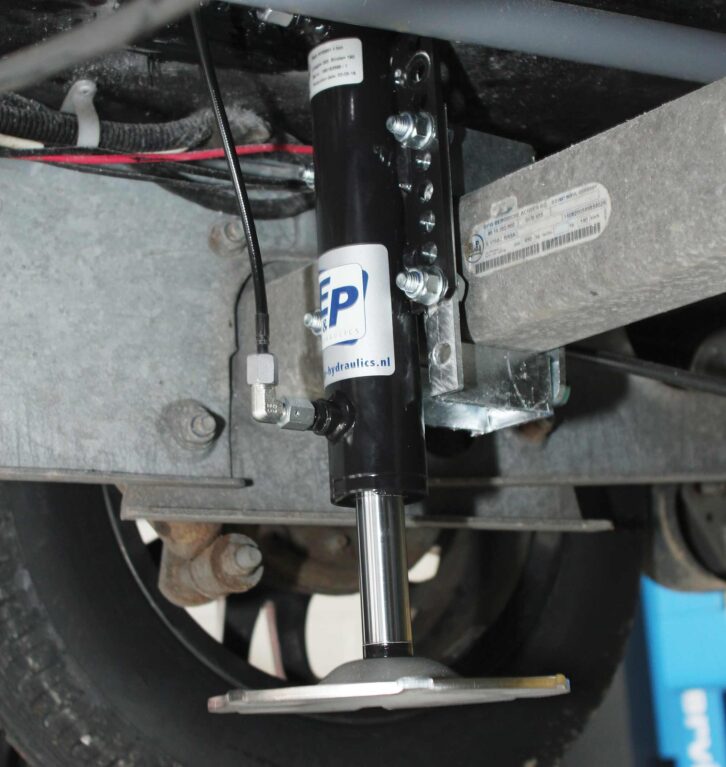
The jockey wheel is used for longitudinal levelling. Both systems are controlled via an interior touchpad or an optional wireless remote, with levelling being achieved at the push of a button.
E&P systems are compatible with a wide range of makes of caravans and models. They can be retrofitted and are also transferable, maintenance friendly and backed by an extensive UK dealer and service network.
HPC Hydraulics
HPC offers hydraulic caravan levelling systems in two versions: C1 (side-to-side) and C3 (fully automatic with electric steadies).
Each axle jack supports up to 2000kg and is powered by a 12V pump. The system is controlled via digital keypad or smartphone app, with levelling completed in about 90 seconds. Features include an anti-theft lock, auto-shutdown and manual override. The total weight to allow for is 25-30kg. C3 combines precision levelling with stabilisation, suitable for either single- or twin-axles.
Supported by a UK dealer network, HPC systems are known for their reliability and functionality.
Ma-Ve
Staffordshire-based Ma-Ve is well known for producing hydraulic levelling systems for motorhomes, and is about offer them for caravans, too. “Our Caravan Levelling is
in final development and will be released at the Düsseldorf Show in August,” says William Bark at Ma-Ve.
“It features full auto-levelling using two electric rear steadies and three hydraulic jacks – two on the axle and one on the A-frame. “Press a button and the van is levelled on both axes, and then the back steadies lower automatically to stabilise it.” Ma-Ve also offers a cost-effective version that winds down the steadies electrically, after you level the van yourself.
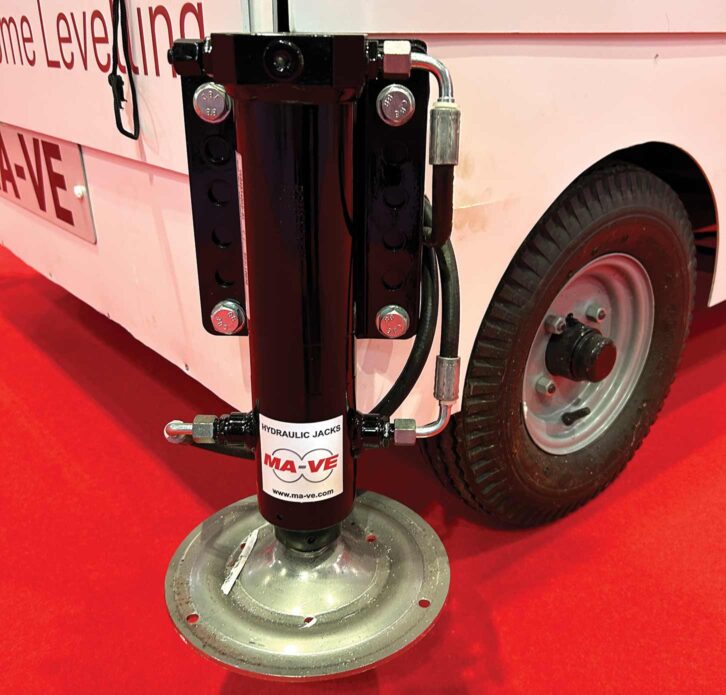
The current motorhome self-levelling system from Ma-Ve comes with four independent actuators, all of which provide a 2500kg load rating and will ensure stable pitching on uneven ground. It’s a completely automatic system, capable of levelling and stabilising either through a 12V control panel or through a Bluetooth app. Each of the legs will then self-adjust through its integrated inclination sensors.
It’s available from approved UK dealers and comes to around 30kg. Other features include safety cut-offs, corrosion-proof components made in anodised aluminium and stainless steel, and manual controls.
For those who are thinking of embarking on an off-grid tour soon, be sure to check out our top tips on how to power a caravan off-grid, to ensure you can keep everything operating in your tourer.
Future Publishing Limited, the publisher of Practical Caravan, provides the information in this article in good faith and makes no representation as to its completeness or accuracy. Individuals carrying out the instructions do so at their own risk and must exercise their independent judgement in determining the appropriateness of the advice to their circumstances and skill level. Individuals should take appropriate safety precautions and be aware of the risk of electrocution when dealing with electrical products. To the fullest extent permitted by law, neither Future nor its employees or agents shall have any liability in connection with the use of this information. You should check that any van warranty will not be affected before proceeding with DIY projects.
If you’ve enjoyed reading this article, why not get the latest news, reviews and features delivered direct to your door or inbox every month. Take advantage of our brilliant Practical Caravan magazine SUBSCRIBERS’ OFFER and SIGN UP TO OUR NEWSLETTER for regular weekly updates on all things caravan related.