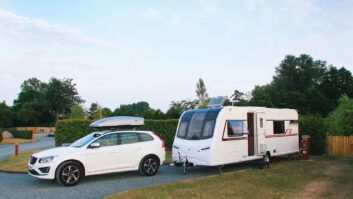
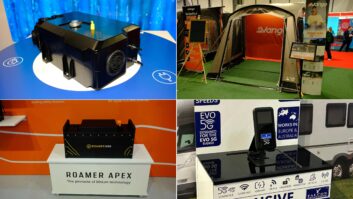
There is a clear and obvious need to decarbonise all areas of our life, and while you might not be fully prepared to invest in an electric tow car just yet, it’s not actually that difficult to dispense with fossil fuels when you are staying on a campsite.
Happily, there are plenty of great products already on the market that will allow you to do so without having to spend thousands on upgrades, and they will ensure you have power for a caravan off-grid.
But you do need to be aware of your energy consumption and use any heavy power consumers with care. While things like LED lights sip energy and can be used without too much of a worry, items like inverters powering heating or cooking equipment are best used sparingly or on a separate power source, such as a battery bank.
So if you’re now considering buying new products for use in your caravan, always check the label (on the base or the reverse) that shows the power they consume in watts.
The lower the wattage, the longer it can run off a battery, so it makes sense to pick the lowest-powered items that you can and avoid using domestic products in your caravan, for example, kettles, toasters and so on. Air fryers are often fine.
The two fundamental building blocks for fossil-free off-grid caravanning are the battery bank and the solar panel array.
Big battery bank
Battery technology is advancing rapidly and now really is the time to invest in a lithium iron phosphate (LiFePO4) battery (see: the pros and cons of lithium batteries). They have several benefits over traditional lead-acid, gel and AGM batteries, the main one being that they are much lighter and more energy dense. They can also be discharged more fully, so their energy can be used more efficiently.
LiFePO4 batteries usually come with an inbuilt battery management system, making them adaptable to most charging set-ups. However, you will need to check your van has a suitable charging profile for lithium, to ensure it is fully topped up.
Modern solar panel regulators should sort out this issue, though, so in practice, it might not be much of a problem.

If you are planning on using several high-powered devices – for example, inverters, coffee machines, hobs, air fryers or heaters – from your 12V supply, you’re going to need a large battery bank, at least 300Ah.
If you don’t use high-powered devices, a simple 100Ah battery might suffice.

The other alternative, which needs no extra wiring or fitting time, is to have a standalone battery bank (such as EcoFlow, Jackery and so on) and use that solely for high-powered devices such as an air fryer.
Solar panels
A caravan solar panel array is essential for successful off-grid camping in the UK. Unlike some of the sunnier parts of Europe, where a smaller 100W solar panel might suffice, in the UK, duller days and shorter daylight hours mean that the panel will rarely operate at its maximum output all of the time.
To compensate for this, you need to go for the maximum output panel(s) that your roof type and payload will allow (take a look at what we have to say about what size solar panel do you need for a caravan for more on this).
A 300W panel operating at 50% of its rated output (for example, on a cloudy day) will still produce the same amount of current as a 150W panel on a sunny day, compensating more effectively for less bright days.

Depending on your tourer, you might want to add several solar panels. These can be wired in series (where the negative and positive terminals of the solar panels are connected together to increase the voltage) or in parallel, where the positive and negative terminals are separate.
There are pros and cons to each method, but crucially for caravan use, parallel wiring is the most tolerant to shading.
With any solar panel, a charge regulator must be used. This manages the power output to ensure batteries are charged as efficiently as possible.
Cheaper models are PWM types (Pulse Width Modulation), while slightly dearer ones use MPPT technology (Maximum Power Point Tracking).

We would stick with MPPT, because it is far more efficient and only slightly more expensive.
Don’t forget to make sure you know how to install caravan solar panels, too.
B2B charger
A battery-to-battery (B2B) charger, such as the Ecoflow Alternator Charger, still relies on fossil fuels as a power source, so is less green than a large solar array.
B2B chargers work by using excess current from the tow car’s alternator to supercharge a battery bank. In the context of this article, they are still ultimately powered by the engine’s fuel. But as you’re driving to the campsite in the first place, using a little fossil fuel is inevitable, so you might as well siphon off extra power to recharge your batteries en route.
Cooking
Traditionally, a gas hob was the go-to device for wild camping and extended off-grid periods, but with a raft of new, highly efficient cooking methods, this is no longer the case.
Starting with the hob, you might want to consider adding an induction hob plate. These handy standalone units can be powered off an inverter, while some of the newer models come with a built-in inverter for maximum ease of use.

Induction hobs are far more efficient than halogen and heat up more rapidly, but they need to be paired with pans with a ferromagnetic base (cast iron, enamelled steel or specialist stainless). Aluminium, copper, glass or thin steel won’t work.
The traditional caravan cooker with a heating element takes too long to heat and cook the food, so the best solution is an air fryer. These tend to be rated at around 1500W, but the speed at which they heat up and their short cooking times make them highly efficient and ideal for caravans.
Heating
Of all the power demands in a caravan, the heating uses the most electricity, unlike cooking, which has a far shorter duration.
As you tend to heat the van in the evenings up to bedtime or even through the night, the duration is over a long period and all the energy has to come from the battery bank.
Solar isn’t going to help at night and few people sit in their van with the heating on in the middle of the day!
So you’re going to need two things: a large battery bank and an efficient heating system.
When you’re choosing the best caravan heater, it’s worth knowing that the least efficient is a fan heater. Newer ceramic models output a fair amount of heat, but you’ll need one rated at 1000-2000W to get any meaningful heat.
A 2000W appliance draws 166A out of a leisure battery – enough to flatten a 150Ah battery in under an hour.
Oil-filled radiators are more efficient, but take a while to heat up and even a modest unit will need to be around 1000W.
The other option is to use smaller, low-current devices, such as an electric blanket. These typically use about 100W, or around 10 times less than a low-powered fan heater, greatly extending batteries’ lifespan.
If you don’t want to go to bed, the other option is a heated coat or gilet. Powered by pocket-sized battery banks charged via your solar panel during the day, they are surprisingly effective. They run for several hours on their battery banks. But they’re a partial solution – they warm your core, rather than radiating heat around the whole tourer.
Cooling
Habitation air conditioning is increasingly popular, but again, these units are large consumers of current that will need to be matched with a sizeable battery bank. They are best operated on an electric mains hook-up.
If you are dead set on air-con, the other option is an efficient standalone unit, such as the EcoFlow Wave, which can run on a battery bank for up to eight hours of air conditioning.
At £700, they’re not cheap, and you need to plug them into a battery source (or pay £1200 for it to come with a battery base), but it’s a simple unit to pack and doesn’t require holes to be cut into the caravan (although you do need to duct a hose out of a window). It also has a heating function, so is a useful device.
Verdict
It used to be hard to stay off-grid and not use gas, but there is now a wide range of efficient cooking and heating equipment to let you camp without consuming fossil fuels. Some are better than gas equivalents, too – in our opinion, an air fryer is better than the gas ovens fitted in some caravans.
Lead image: Alamy
Future Publishing Limited, the publisher of Practical Caravan, provides the information in this article in good faith and makes no representation as to its completeness or accuracy. Individuals carrying out the instructions do so at their own risk and must exercise their independent judgement in determining the appropriateness of the advice to their circumstances and skill level. Individuals should take appropriate safety precautions and be aware of the risk of electrocution when dealing with electrical products. To the fullest extent permitted by law, neither Future nor its employees or agents shall have any liability in connection with the use of this information. You should check that any van warranty will not be affected before proceeding with DIY projects.
If you enjoyed reading this article, why not get the latest news, reviews and features delivered to your door or inbox every month? Take advantage of our brilliant Practical Caravan SUBSCRIBERS’ OFFER and SIGN UP TO OUR NEWSLETTER for regular weekly updates on all things caravan related.